
|
市場調査レポート
商品コード
1550270
欧州のデジタルトランスフォーメーション:市場シェア分析、産業動向・統計、成長予測(2024年~2029年)Europe Digital Transformation - Market Share Analysis, Industry Trends & Statistics, Growth Forecasts (2024 - 2029) |
||||||
カスタマイズ可能
適宜更新あり
|
|||||||
| 欧州のデジタルトランスフォーメーション:市場シェア分析、産業動向・統計、成長予測(2024年~2029年) |
|
出版日: 2024年09月02日
発行: Mordor Intelligence
ページ情報: 英文 140 Pages
納期: 2~3営業日
|
全表示
- 概要
- 目次
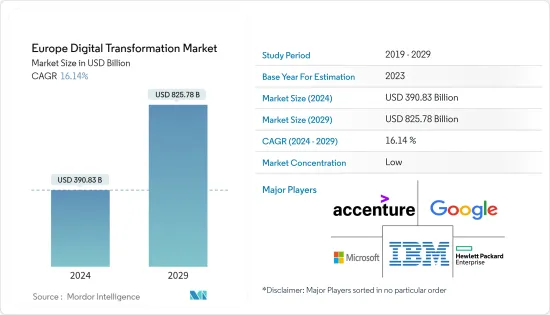
欧州のデジタルトランスフォーメーション市場規模は2024年に3,908億3,000万米ドルと推定され、2029年には8,257億8,000万米ドルに達すると予測され、予測期間中(2024年~2029年)のCAGRは16.14%で成長すると予測されます。
主なハイライト
- 欧州ではデジタルトランスフォーメーションが著しい成長を遂げ、産業と経済のダイナミクスが根本的に変化しています。この進化には、ビジネス機能全体にわたるデジタル技術の広範な統合が含まれ、業務パラダイムと顧客価値提案を再構築しています。欧州のデジタルトランスフォーメーションの主な促進要因には、技術の進歩、消費者行動の進化、政府の戦略的イニシアチブなどがあり、これらはすべてイノベーションと競合の強化を目的としています。
- 欧州各国政府は、様々な政策やイニシアティブを通じてデジタルトランスフォーメーションを積極的に推進しています。欧州連合のデジタル戦略は、イノベーションを促進し、インフラを改善し、公正で競争力のあるデジタル経済を確保することで、欧州をデジタル時代に適合したものにすることを目的としています。デジタル・欧州・プログラムや一般データ保護規則(GDPR)などのイニシアチブは、消費者の権利を保護しつつ、デジタル・イノベーションを促進する環境を整えるものです。2023年12月、欧州委員会2024は、EUデジタル・欧州・プログラムの修正案を承認し、8億2,909万米ドルを割り当てた。この資金は、欧州全域のデジタル変革を推進し、市民生活の向上、公共サービスの強化、加盟国内の企業の活性化に重点を置くことを目的としています。
- さらに、欧州ではさまざまな分野でデジタル化が進んでいます。例えば、欧州の小売業界はeコマースへと大きくシフトしています。オンライン・ショッピング・プラットフォーム、デジタル決済システム、パーソナライズされたマーケティング戦略が小売業を変革しています。小売企業は、消費者行動をよりよく理解し、サプライチェーンを最適化するためにデータ分析を利用しています。オンラインマーケットプレースや消費者直販ブランドの台頭は、この分野の競合力学を変えつつあります。
- 2024年3月、ドイツの小売企業REWE Groupは、イスラエルの新興企業Catchと提携し、スマートカート、スマートフォン、セルフレジのキオスク端末にまたがる多目的プラットフォームCatch AIのトライアルを開始しました。このイノベーションにより、買い物客は手書きのリストをスキャンしたり、タブレット経由でデジタルリストをシームレスに転送できるようになります。特筆すべきは、このシステムがユーザーの匿名性を優先し、登録やアプリのダウンロードを不要にしていることです。
- さらに、欧州のデジタルトランスフォーメーションは明るい未来に向かっています。テクノロジーの絶え間ない進化により、企業にも公的機関にも新たな道が開かれようとしています。このデジタルの勢いを維持するためには、新興テクノロジーへの一貫した投資、労働力のスキル強化、サイバーセキュリティの優先順位付けが不可欠です。さらに、政府、産業界、学界の間でパートナーシップを育むことは、ハードルに取り組み、この変革の成果を増幅する上で極めて重要です。デジタル経済の育成に熱心で、革新的な遺産を深く根付かせている欧州は、世界のデジタル分野で主導権を握る用意があります。
欧州のデジタルトランスフォーメーション市場動向
人工知能の需要拡大
- 欧州では、AIの導入が重要な動向になると分析されています。欧州には先進的な研究開発(R&D)エコシステムがあります。機械学習、自然言語処理、ロボット工学の革新がAIの採用を加速させています。欧州大陸の強力な学術機関と官民の協力体制が、こうした技術的進歩に拍車をかけています。
- さらにアマゾンによると、欧州のビジネスにおけるAIの成長は継続的に拡大しています。欧州企業では過去1年間にAIの導入が32%急増し、現在では約3分の1がAI技術を活用しています。この動向が持続すれば、2030年までに推定6,520億米ドルの粗付加価値(GVA)が欧州経済にもたらされることになります。オランダを拠点とするAWSのスケールアップ企業Growyは、この動向を象徴しています。モノのインターネット(IoT)とともにAIを活用するGrowyは、完全自動化されたロボット化農場を管理し、持続可能性の育成におけるAIの可能性を示しています。こうした進歩は、欧州におけるより広範な動向を裏付けるものであり、同地域のAI市場を前進させています。
- また、欧州各国政府はAIの戦略的重要性を認識し、その発展を促進するための様々な政策に着手しています。2024年1月、欧州委員会は新たなAI施策パッケージを発表しました。これらの施策と並行して、欧州委員会は、2024年2月に正式業務を開始する予定の欧州AI事務局の設立も発表しました。これにより、欧州委員会は、AI革新戦略により、欧州連合(EU)が先進的なAIモデル、システム、アプリケーションの世界のフロントランナーとなる可能性を十分に発揮できるよう支援する意向です。このような取り組みは、欧州をAIにおける成長地域と位置づけるためのものです。
- さらに、インダストリー4.0は、製造・生産プロセスにおけるAIの統合を推進しています。欧州の産業界では、業務効率の向上、コスト削減、製品やサービスの革新のためにAIの導入が進んでいます。ビジネスのデジタルトランスフォーメーションが重要な推進力となっています。また、研究とイノベーションへの投資も拡大しています。ドイツ研究省によると、ドイツはAI研究とイノベーションに約5億4,350万米ドルを投資し、スーパーコンピューティング・インフラやスキル開発などに投資することを約束しています。
- 需要が高まるにつれて、AIの採用を増やすために官民でいくつかのイニシアティブが取られています。例えば、ドイツは2024年7月にコンソーシアムを設立し、ロボット工学の主要拠点となるドイツロボット工学研究所を設立しました。この構想は、ドイツ人工知能研究センターの支援を受けて、ドイツ連邦教育研究省から今後4年間で2,170万米ドルの多額の資金提供を受けることになっています。
大きな市場シェアを占める英国
- 英国は、デジタルトランスフォーメーションの著しい成長を目の当たりにし、その経済的・社会的景観を根本的に再構築しています。英国のデジタルトランスフォーメーションへの取り組みは、技術の進歩、消費者行動の変化、世界化した経済における競争優位性の必要性などに後押しされ、さまざまな分野で顕著になっています。また、人工知能(AI)、機械学習、ブロックチェーン、モノのインターネット(IoT)などの先端技術の普及は、英国のデジタルトランスフォーメーションの最前線となっています。これらのテクノロジーは、企業が業務を最適化し、顧客体験を向上させ、新しい製品やサービスを革新することを可能にしています。
- さらに、人工知能(AI)、機械学習、ブロックチェーン、モノのインターネット(IoT)などの先端技術の普及は、英国のデジタル変革の最前線にあります。これらのテクノロジーは、企業が業務を最適化し、顧客体験を向上させ、新しい製品やサービスを革新することを可能にしています。
- さらに、英国ではウェアラブル端末の導入が急増しています。YouGovが実施した調査によると、回答者の半数が現在ウェアラブル端末を所有していることに同意しています。ウェアラブル端末を導入する人が増え、同国のデジタルトランスフォーメーションを後押しすることが期待されます。
- また、英国における銀行、保険、ヘルスケア、ビジネスサービスのデジタル化は、同国におけるAIとMLの成長の重要な原動力となっています。同国はICTのインフラも発達しており、新興諸国の増加は同国のデジタルトランスフォーメーションの成長に大きく貢献すると思われます。2024年6月、ベンチャーキャピタルのアクセルが221のGenAIスタートアップを調査したところ、これらの革新的ベンチャーの30%が英国発であることが明らかになった。これらの新興企業は、膨大なデータセットで訓練されたモデルを活用して、テキスト、画像、動画、その他のデータなどのコンテンツを作成することに特化しています。この動向は、近い将来、市場の成長を大きく後押しすることになると思われます。
欧州のデジタルトランスフォーメーション産業の概要
欧州のデジタルトランスフォーメーション市場は、多くのプレーヤーが存在するため、非常に断片化されています。デジタルトランスフォーメーション市場の主要企業数社は、進歩をもたらすために絶え間ない努力を続けています。数少ない著名な企業は、共同事業に参入し、発展途上地域での足跡を拡大することで、その地位を固めています。Accenture PLC、Google LLC(Alphabet Inc.)、IBM Corporation、Microsoft Corporationなどが市場の主要企業です。
- 2024年7月AMDは、総額約6億6,500万米ドルの現金取引で、欧州の大手民間AIラボであるSilo AIを買収する契約を締結しました。この動きは、オープンスタンダードに基づいた包括的なAIソリューションを提供し、世界なAIコミュニティ内でのコラボレーションを促進するというAMDのコミットメントを強調するものです。
- 2024年6月EUデジタルツインオーシャンプラットフォーム(EDITO-Infra)がVLPFによって最近立ち上げられました。欧州委員会からの1,000万ユーロ(1,093万米ドル)の投資を受けたこのイニシアチブは、海洋資源管理に革命をもたらし、ブルーエコノミーの持続可能性を高めることを目的としています。
その他の特典
- エクセル形式の市場予測(ME)シート
- 3ヶ月間のアナリスト・サポート
目次
第1章 イントロダクション
- 調査の前提条件と市場定義
- 調査範囲
第2章 調査手法
第3章 エグゼクティブサマリー
第4章 産業エコシステム分析(デジタルトランスフォーメーション産業の主要利害関係者を詳細にカバー、製品/ソリューションプロバイダー、システムインテグレーター/VAR、コネクティビティプロバイダー、規制機関、エンドユーザー、サービスプロバイダーなど)
第5章 市場力学
- 市場促進要因
- 同地域におけるビッグデータ解析やその他の技術の導入の増加
- モバイル機器とアプリの急速な普及
- 市場抑制要因
- 情報のプライバシーとセキュリティに対する懸念
第6章 現在の市場シナリオとデジタルトランスフォーメーションの進化
第7章 主要指標
- テクノロジー支出動向
- IoTデバイス数
- サイバー攻撃の総件数
- 技術スタッフの動向
- インターネット普及率
- デジタル競合ランキング
- 固定およびモバイル・ブロードバンド普及率
- クラウドの採用
- AIの普及
- eコマースの普及率
第8章 市場セグメンテーション
- タイプ別
- 人工知能と機械学習
- 現在の市場シナリオと予測期間の市場予測
- 主な成長要因(促進要因、課題、機会)
- 使用事例分析
- 市場展望
- 拡張現実(VRとAR)
- 現在の市場シナリオと予測期間の市場予測
- 主な成長インフルエンサー(促進要因、課題、機会)
- 使用事例分析
- 市場展望
- IoT市場
- 現在の市場シナリオと予測期間の市場予測
- 主な成長インフルエンサー(促進要因、課題、機会)
- 使用事例分析
- 市場展望
- 産業用ロボット
- 現在の市場シナリオと予測期間の市場予測
- 主要成長インフルエンサー(促進要因、課題、機会)
- 使用事例分析
- 市場展望
- ブロックチェーン
- 現在の市場シナリオと予測期間の市場予測
- 主な成長インフルエンサー(促進要因、課題、機会)
- 市場展望
- 積層造形/3Dプリンティング
- 現在の市場シナリオと予測期間の市場予測
- 主な成長インフルエンサー(促進要因、課題、成長機会)
- 使用事例分析
- 市場展望
- サイバーセキュリティ
- 現在の市場シナリオと予測期間の市場予測
- 主な成長要因(促進要因、課題、機会)
- 使用事例分析
- 市場展望
- クラウドエッジコンピューティング
- 現在の市場シナリオと予測期間の市場予測
- 主な成長インフルエンサー(促進要因、課題、機会)
- 使用事例分析
- 市場展望
- その他(デジタルツイン、モビリティ、コネクティビティ)
- 現在の市場シナリオと予測期間の市場予測
- 主な成長インフルエンサー(促進要因、課題、機会)
- タイプ別市場内訳(デジタルツイン、モビリティ、コネクティビティ)
- 使用事例分析
- 市場展望
- 人工知能と機械学習
- エンドユーザー産業別
- 製造業
- 石油・ガス・公益事業
- 小売・eコマース
- 運輸・物流
- ヘルスケア
- BFSI
- 通信・IT
- 政府・公共部門
- その他(教育、メディア&エンターテイメント、環境など)
- 国別
- ドイツ
- フランス
- 英国
- イタリア
- スペイン
- その他の欧州諸国
第9章 競合情勢
- 企業プロファイル
- Google LLC(Alphabet Inc.)
- IBM Corporation
- Microsoft Corporation
- Oracle Corporation
- Accenture PLC
- Cognex Corporation
- Hewlett Packard Enterprise
- SAP SE
- EMC Corporation(Dell EMC)
- Adobe Inc.
- Siemens AG
第10章 主要な変革技術
- 量子コンピューティング
- Manufacturing as a Service(MaaS)
- コグニティブ・プロセス・オートメーション
- ナノテクノロジー
The Europe Digital Transformation Market size is estimated at USD 390.83 billion in 2024, and is expected to reach USD 825.78 billion by 2029, growing at a CAGR of 16.14% during the forecast period (2024-2029).
Key Highlights
- Europe is experiencing significant growth in digital transformation, fundamentally altering industries and economic dynamics. This evolution involves the widespread integration of digital technologies across business functions, reshaping operational paradigms and customer value propositions. Key drivers behind Europe's digital transformation include technological advancements, evolving consumer behaviors, and strategic governmental initiatives, all aimed at enhancing innovation and competitiveness.
- European governments are actively promoting digital transformation through various policies and initiatives. The European Union's Digital Strategy aims to make Europe fit for the digital age by fostering innovation, improving infrastructure, and ensuring a fair and competitive digital economy. Initiatives such as the Digital Europe Programme and the General Data Protection Regulation (GDPR) create a conducive environment for digital innovation while protecting consumer rights. In December 2023, The European Commission 2024 approved an amendment to the EU Digital Europe Program, allocating a substantial USD 829.09 million. This funding is specifically earmarked to drive digital transformations across Europe, focusing on enhancing citizens' lives, bolstering public services, and empowering businesses within the member states.
- Further, various sectors in Europe are witnessing an adoption of digitalization. For instance, the European retail industry has substantially shifted towards e-commerce. Online shopping platforms, digital payment systems, and personalized marketing strategies are transforming retail. Retailers use data analytics to understand consumer behavior better and optimize supply chains. The rise of online marketplaces and direct-to-consumer brands is changing the sector's competitive dynamics.
- In March 2024, German retailer REWE Group partnered with Israeli startup Catch to trial Catch AI, a versatile platform spanning smart carts, smartphones, and self-checkout kiosks. This innovation empowers shoppers to scan handwritten lists or seamlessly transfer digital lists via a tablet. Notably, the system prioritizes user anonymity, eliminating the need for registrations or app downloads.
- Moreover, Europe's digital transformation is poised for a bright future. With technology's relentless evolution, fresh avenues are set to open up for both businesses and public sector entities. To maintain this digital momentum, it's imperative to consistently invest in emerging technologies, enhance workforce skills, and prioritize cybersecurity. Moreover, fostering partnerships among governments, industries, and academia is pivotal to tackling hurdles and amplifying this transformation's gains. Given Europe's dedication to nurturing a digital economy and its deep-rooted innovative legacy, the continent stands primed to take the helm in the worldwide digital arena.
Europe Digital Transformation Market Trends
Growing Demand of Artificial Intelligence
- The adoption of AI is analyzed to be a significant trend in Europe. Europe is home to an advanced research and development (R&D) ecosystem. Innovations in machine learning, natural language processing, and robotics are accelerating the adoption of AI. The continent's strong academic institutions and collaboration between public and private sectors are fueling these technological advancements.
- Further, according to Amazon, the growth of AI in European business is continiously growing. European businesses have seen a 32% surge in AI adoption over the past year, with approximately one-third now leveraging AI technologies. This trend, if sustained, is poised to cater an estimated USD 652 billion in gross value added (GVA) into the European economy by 2030. Highlighting this shift, Growy, a Netherlands-based AWS scale-up, exemplifies the trend. Utilizing AI alongside the Internet of Things (IoT), Growy manages its fully automated, robotized farms, showcasing the potential of AI in fostering sustainability. These advancements underscore a broader trend in Europe, propelling the region's AI market forward.
- Also, European governments recognized the strategic importance of AI and have initiated various policies to foster its development. In January 2024, the European Commission announced a new package of AI measures. Alongside these measures, the Commission also announced the creation of the European AI Office, which is due to begin formal operations in February 2024. With this, the Commission intends for the AI Innovation Strategy to help the European Union to fullfill its potential of becoming a global frontrunner in advanced AI models, systems, and applications. Such initiatives are designed to position Europe as a growing region in AI.
- Moreover, the industry 4.0, is driving the integration of AI in manufacturing and production processes. European industries are increasingly adopting AI to enhance operational efficiency, reduce costs, and innovate products and services. The digital transformation of businesses is a key driver. Also, there has been a growing investment in research and innovation. According to Research Ministry Germany, Germany promises to invest almost USD 543.5 million in AI research and innovation with investments in supercomputing infrastructure, skills development, and others.
- As the demand grows there has been several innitiatives taken by the public and private sector to increase the adoption of AI. For instance, in July 2024, Germany established a consortium to create the Robotics Institute Germany, serving as the nation's primary hub for robotics. The initiative is set to receive a substantial USD 21.7 million in funding from the German Federal Ministry of Education and Research over the next four years, with backing from the German Research Center for Artificial Intelligence.
United Kingdom to Hold Significant Market Share
- The United Kingdom is witnessing significant growth in digital transformation, fundamentally reshaping its economic and social landscape. The UK's commitment to digital transformation is evident across various sectors, driven by technological advancements, consumer behavior changes, and the need for competitive advantage in a globalized economy. Also, the proliferation of advanced technologies such as artificial intelligence (AI), machine learning, blockchain, and the Internet of Things (IoT) is at the forefront of the UK's digital transformation. These technologies are enabling businesses to optimize operations, enhance customer experiences, and innovate new products and services.
- Further, the proliferation of advanced technologies such as artificial intelligence (AI), machine learning, blockchain, and the Internet of Things (IoT) is at the forefront of the UK's digital transformation. These technologies are enabling businesses to optimize operations, enhance customer experiences, and innovate new products and services.
- In addition, the UK is witnessing a surge in the adoption of wearable devices. According to a survey conducted by YouGov, half of the respondents agreed that they currently own a wearable device. More people are expected to adopt wearable devices, which will boost the country's digital transformation.
- Also, the digitalization of banking, insurance, healthcare, and business services in the United Kingdom is the key driver for the growth of AI and ML in the country. The country also has a well-developed infrastructure of ICT, and the increasing number of start-ups will significantly contribute to the growth of digital transformation in the country. In June 2024, Accel, a venture capital firm, examined 221 GenAI startups, revealing that 30% of these innovative ventures originated in the UK. These startups specialize in creating content be it text, images, videos, or other data leveraging models trained on vast datasets. This trend is poised to significantly propel the market's growth in the near future.
Europe Digital Transformation Industry Overview
The Europe Digital Transformation Market is highly fragmented due to the presence of many players. Several key players in the Digital Transformation market are in constant efforts to bring advancements. A few prominent companies enter collaborations and expand their footprints in developing regions to consolidate their positions. Accenture PLC, Google LLC (Alphabet Inc.), IBM Corporation, Microsoft Corporation, and others are the major players in the market.
- July 2024 : AMD has finalized a deal to acquire Silo AI, Europe's leading private AI lab, in a cash transaction totaling around USD 665 million. This move underscores AMD's commitment to providing comprehensive AI solutions built on open standards and fostering collaborations within the global AI community.
- June 2024 : The EU Digital Twin Ocean platform (EDITO-Infra) was recently launched by VLPF. Backed by EUR10 million (USD 10.93 million) investment from the European Commission, this initiative aims to revolutionize ocean resource management, enhancing the sustainability of blue economies.
Additional Benefits:
- The market estimate (ME) sheet in Excel format
- 3 months of analyst support
TABLE OF CONTENTS
1 INTRODUCTION
- 1.1 Study Assumptions and Market Definition
- 1.2 Scope of the Study
2 RESEARCH METHODOLOGY
3 EXECUTIVE SUMMARY
4 INDUSTRY ECOSYSTEM ANALYSIS (Detailed Coverage of Key Stakeholders in Digital Transformation Industry Product/Solution Providers, System Integrators/VARs, Connectivity Providers, Regulatory Bodies, End-users, Service Providers, etc.)
5 MARKET DYNAMICS
- 5.1 Market Drivers
- 5.1.1 Increase in the adoption of big data analytics and other technologies in the region
- 5.1.2 The rapid proliferation of mobile devices and apps
- 5.2 Market Restraints
- 5.2.1 Concerns about the Privacy and Security of Information
6 CURRENT MARKET SCENARIO AND EVOLUTION OF DIGITAL TRANSFORMATION PRACTICES
7 KEY METRICS
- 7.1 Technology Spending Trends
- 7.2 Number of IoT Devices
- 7.3 Total Cyberattacks
- 7.4 Technology Staffing Trends
- 7.5 Internet growth and penetration in the region
- 7.6 Digital Competitiveness Ranking
- 7.7 fixed and mobile broadband coverage
- 7.8 Cloud adoption
- 7.9 AI adoption
- 7.10 E-commerce penetration
8 MARKET SEGMENTATION
- 8.1 By Type
- 8.1.1 Artificial Intelligence and Machine Learning
- 8.1.1.1 Current Market Scenario and Market Projections for the Forecast Period
- 8.1.1.2 Key Growth Influencers (Drivers, Challenges, and Opportunities)
- 8.1.1.3 Use Case Analysis
- 8.1.1.4 Market Outlook
- 8.1.2 Extended Reality (VR & AR)
- 8.1.2.1 Current Market Scenario and Market Projections for the Forecast Period
- 8.1.2.2 Key Growth Influencers (Drivers, Challenges, and Opportunities)
- 8.1.2.3 Use Case Analysis
- 8.1.2.4 Market Outlook
- 8.1.3 IoT
- 8.1.3.1 Current Market Scenario and Market Projections for the Forecast Period
- 8.1.3.2 Key Growth Influencers (Drivers, Challenges, and Opportunities)
- 8.1.3.3 Use Case Analysis
- 8.1.3.4 Market Outlook
- 8.1.4 Industrial Robotics
- 8.1.4.1 Current Market Scenario and Market Projections for the Forecast Period
- 8.1.4.2 Key Growth Influencers (Drivers, Challenges, and Opportunities)
- 8.1.4.3 Use Case Analysis
- 8.1.4.4 Market Outlook
- 8.1.5 Blockchain
- 8.1.5.1 Current Market Scenario and Market Projections for the Forecast Period
- 8.1.5.2 Key Growth Influencers (Drivers, Challenges, and Opportunities)
- 8.1.5.3 Market Outlook
- 8.1.6 Additive Manufacturing/3D Printing
- 8.1.6.1 Current Market Scenario and Market Projections for the Forecast Period
- 8.1.6.2 Key Growth Influencers (Drivers, Challenges, and Opportunities)
- 8.1.6.3 Use Case Analysis
- 8.1.6.4 Market Outlook
- 8.1.7 Cybersecurity
- 8.1.7.1 Current Market Scenario and Market Projections for the Forecast Period
- 8.1.7.2 Key Growth Influencers (Drivers, Challenges, and Opportunities)
- 8.1.7.3 Use Case Analysis
- 8.1.7.4 Market Outlook
- 8.1.8 Cloud Edge Computing
- 8.1.8.1 Current Market Scenario and Market Projections for the Forecast Period
- 8.1.8.2 Key Growth Influencers (Drivers, Challenges, and Opportunities)
- 8.1.8.3 Use Case Analysis
- 8.1.8.4 Market Outlook
- 8.1.9 Others (digital twin, mobility and connectivity)
- 8.1.9.1 Current Market Scenario and Market Projections for the Forecast Period
- 8.1.9.2 Key Growth Influencers (Drivers, Challenges, and Opportunities)
- 8.1.9.3 Market Breakdown by Type (Digital Twin, Mobility and Connectivity)
- 8.1.9.4 Use Case Analysis
- 8.1.9.5 Market Outlook
- 8.1.1 Artificial Intelligence and Machine Learning
- 8.2 By End-User Industry
- 8.2.1 Manufacturing
- 8.2.2 Oil, Gas and Utilities
- 8.2.3 Retail & e-commerce
- 8.2.4 Transportation and Logistics
- 8.2.5 Healthcare
- 8.2.6 BFSI
- 8.2.7 Telecom and IT
- 8.2.8 Government and Public Sector
- 8.2.9 Others (Education, Media & Entertainment, Environment etc)
- 8.3 By Country
- 8.3.1 Germany
- 8.3.2 France
- 8.3.3 United Kingdom
- 8.3.4 Italy
- 8.3.5 Spain
- 8.3.6 Other European Countries
9 COMPETITIVE LANDSCAPE
- 9.1 Company Profiles
- 9.1.1 Google LLC (Alphabet Inc.)
- 9.1.2 IBM Corporation
- 9.1.3 Microsoft Corporation
- 9.1.4 Oracle Corporation
- 9.1.5 Accenture PLC
- 9.1.6 Cognex Corporation
- 9.1.7 Hewlett Packard Enterprise
- 9.1.8 SAP SE
- 9.1.9 EMC Corporation (Dell EMC)
- 9.1.10 Adobe Inc.
- 9.1.11 Siemens AG
10 KEY TRANSFORMATIVE TECHNOLOGIES
- 10.1 Quantum Computing
- 10.2 Manufacturing as a Service (MaaS)
- 10.3 Cognitive Process Automation
- 10.4 Nanotechnology