|
市場調査レポート
商品コード
1572933
再生医療市場:世界の産業分析、規模、シェア、成長、動向、予測、2024年~2031年Regenerative Medicine Market: Global Industry Analysis, Size, Share, Growth, Trends, and Forecast, 2024-2031 |
||||||
|
|
|||||||
カスタマイズ可能
|
|||||||
| 再生医療市場:世界の産業分析、規模、シェア、成長、動向、予測、2024年~2031年 |
|
出版日: 2024年10月14日
発行: Persistence Market Research
ページ情報: 英文 249 Pages
納期: 2~5営業日
|
全表示
- 概要
- 目次
Persistence Market Research社はこのほど、世界の再生医療市場に関する包括的なレポートを発表しました。当レポートでは、市場促進要因・動向・機会・促進要因・課題などの重要な市場ダイナミクスを徹底的に評価し、市場構造に関する詳細な洞察を提供しています。この調査レポートは、2024年から2031年までの世界の再生医療市場の予測成長軌道を概説する独占データと統計を掲載しています。
主な洞察
- 再生医療市場規模(2024年):3,230万米ドル
- 予測市場規模(2031年):1億940万米ドル
- 世界市場成長率(CAGR 2024年~2031年):19.1%
再生医療市場 - レポート範囲:
再生医療には、損傷した組織や臓器を修復、置換、再生して正常な機能を回復させることを目的とした様々な治療アプローチが含まれます。この市場には、幹細胞治療、組織工学、遺伝子治療、その他の革新的技術が含まれます。再生医療は、慢性疾患、怪我、加齢に伴う障害など、様々な病状に対処する可能性を秘めており、ヘルスケア分野における研究開発の重要な分野となっています。同市場は、病院、研究機関、バイオ製薬会社に対応し、多様な治療法や製品を提供しています。
市場成長の促進要因:
世界の再生医療市場は、慢性疾患の増加、幹細胞研究の進歩、バイオテクノロジーやヘルスケアインフラへの投資の増加など、いくつかの主要な要因によって推進されています。糖尿病、心血管疾患、神経変性疾患などの疾患に対する実行可能な治療オプションとしての再生療法に対する認識の高まりが、市場拡大をさらに後押ししています。さらに、臨床試験の増加と革新的な治療法の商業化は、再生医療ソリューションの受け入れと需要の拡大に寄与しています。
市場抑制要因:
有望な成長展望にもかかわらず、再生医療市場は、規制のハードル、高い開発コスト、幹細胞研究を取り巻く倫理的懸念に関連する課題に直面しています。再生療法の承認と商業化を管理する厳しい規制は、市場参入を遅らせ、メーカーの運営コストを増加させる可能性があります。さらに、再生医療製品の開発に伴う複雑さと高コストは、特にヘルスケア資源に乏しい新興経済諸国において、アクセシビリティを阻害する可能性があります。これらの課題に対処するためには、明確なガイドラインを策定し、再生療法への公平なアクセスを促進するために、業界の利害関係者、規制機関、政策立案者が協力する必要があります。
市場機会:
再生医療市場は、技術の進歩、ヘルスケア支出の増加、患者中心のアプローチの進化を原動力とする大きな成長機会を示しています。CRISPRなどの遺伝子編集技術の革新やバイオプリンティング技術の開発は、個別化再生療法の可能性を高めています。さらに、整形外科、腫瘍学、創傷治癒などの分野における再生医療応用への注目の高まりは、市場範囲を拡大し、研究開発努力を刺激します。戦略的パートナーシップ、臨床試験への投資、費用対効果の高い再生ソリューションのイントロダクションは、新たな機会を活用し、このダイナミックな分野で市場のリーダーシップを維持するために不可欠です。
本レポートで扱う主な質問
- 再生医療市場の世界の成長を促進する主な要因は何か?
- 再生医療の採用が増加している治療分野と用途は何か?
- 技術の進歩は再生医療市場の競合情勢をどのように変えているのか?
- 再生医療市場に貢献している主要企業はどこで、市場の関連性を維持するためにどのような戦略を採用しているのか?
- 世界の再生医療市場における新たな動向と将来性は?
目次
第1章 エグゼクティブサマリー
第2章 市場概要
- 市場の範囲と定義
- 市場力学
- 促進要因
- 抑制要因
- 機会
- 課題
- 主な動向
- マクロ経済要因
- 世界のセクター別展望
- 世界のGDP成長展望
- 世界のヘルスケア費支出展望
- COVID-19の影響分析
- 予測要因- 関連性と影響
第3章 付加価値のある洞察
- 製品採用分析
- 技術評価
- 規制状況
- バリューチェーン分析
- 流通チャネル/マーケットプレイス一覧
- 小売
- 聴覚学
- eコマース
- エンドユーザー(業界)リスト
- 流通チャネル/マーケットプレイス一覧
- 主要な取引と合併
- PESTLE分析
- ポーターのファイブフォース分析
第4章 世界の再生医療市場の展望:実績(2019年~2023年)と予測(2024年~2031年)
- 主なハイライト
- 市場規模と前年比成長率
- 絶対的額の機会
- 市場規模分析と予測
- 過去の市場規模分析:2019年~2023年
- 現在の市場規模分析と予測:2024年~2031年
- 世界の再生医療市場の展望:医薬品タイプ別
- イントロダクション/主な調査結果
- 過去の市場規模分析:医薬品タイプ別、2019年~2023年
- 現在の市場規模分析と予測:医薬品タイプ別、2024年~2031年
- 抗血小板薬
- 糖タンパク質IIb/IIIa阻害剤
- 抗血栓剤
- ベータ遮断薬
- 市場の魅力分析:医薬品タイプ別
- 世界の再生医療市場の展望:投与経路別
- イントロダクション/主な調査結果
- 過去の市場規模分析:投与経路別、2019年~2023年
- 現在の市場規模分析と予測:投与経路別、2024年~2031年
- 経口
- 注射可能
- 市場の魅力分析:投与経路別
- 世界の再生医療市場の展望:流通チャネル別
- イントロダクション/主な調査結果
- 過去の市場規模分析:流通チャネル別、2019年~2023年
- 現在の市場規模分析と予測:流通チャネル別、2024年~2031年
- 病院
- クリニック
- 小売薬局
- オンライン薬局
- 市場の魅力分析:流通チャネル別
第5章 世界の再生医療市場の展望:地域別
- 主なハイライト
- 過去の市場規模分析:地域別、2019年~2023年
- 現在の市場規模分析と予測:地域別、2024年~2031年
- 北米
- 欧州
- 東アジア
- 南アジアとオセアニア
- ラテンアメリカ
- 中東・アフリカ
- 市場の魅力分析:地域別
第6章 北米の再生医療市場の展望:実績(2019年~2023年)と予測(2024年~2031年)
- 主なハイライト
- 価格分析
- 過去の市場規模分析:市場別、2019年~2023年
- 国別
- 医薬品タイプ別
- 投与経路別
- 流通チャネル別
- 現在の市場規模分析と予測:国別、2024年~2031年
- 米国
- カナダ
- 現在の市場規模分析と予測:医薬品タイプ別、2024年~2031年
- 抗血小板薬
- 糖タンパク質IIb/IIIa阻害剤
- 抗血栓剤
- ベータ遮断薬
- 現在の市場規模分析と予測:投与経路別、2024年~2031年
- 経口
- 注射可能
- 現在の市場規模分析と予測:流通チャネル別、2024年~2031年
- 病院
- クリニック
- 小売薬局
- オンライン薬局
- 市場の魅力分析
第7章 欧州の再生医療市場の展望:実績(2019年~2023年)と予測(2024年~2031年)
- 主なハイライト
- 価格分析
- 過去の市場規模分析:市場別、2019年~2023年
- 国別
- 医薬品タイプ別
- 投与経路別
- 流通チャネル別
- 現在の市場規模分析と予測:国別、2024年~2031年
- ドイツ
- フランス
- 英国
- イタリア
- スペイン
- ロシア
- トルコ
- その他欧州
- 現在の市場規模分析と予測:医薬品タイプ別、2024年~2031年
- 抗血小板薬
- 糖タンパク質IIb/IIIa阻害剤
- 抗血栓剤
- ベータ遮断薬
- 現在の市場規模分析と予測:投与経路別、2024年~2031年
- 経口
- 注射可能
- 現在の市場規模分析と予測:流通チャネル別、2024年~2031年
- 病院
- クリニック
- 小売薬局
- オンライン薬局
- 市場の魅力分析
第8章 東アジアの再生医療市場の展望:実績(2019年~2023年)と予測(2024年~2031年)
- 主なハイライト
- 価格分析
- 過去の市場規模分析:市場別、2019年~2023年
- 国別
- 医薬品タイプ別
- 投与経路別
- 流通チャネル別
- 現在の市場規模分析と予測:国別、2024年~2031年
- 中国
- 日本
- 韓国
- 現在の市場規模分析と予測:医薬品タイプ別、2024年~2031年
- 抗血小板薬
- 糖タンパク質IIb/IIIa阻害剤
- 抗血栓剤
- ベータ遮断薬
- 現在の市場規模分析と予測:投与経路別、2024年~2031年
- 経口
- 注射可能
- 現在の市場規模分析と予測:流通チャネル別、2024年~2031年
- 病院
- クリニック
- 小売薬局
- オンライン薬局
- 市場の魅力分析
第9章 南アジア・オセアニアの再生医療市場の展望:実績(2019年~2023年)と予測(2024年~2031年)
- 主なハイライト
- 価格分析
- 過去の市場規模分析:市場別、2019年~2023年
- 国別
- 医薬品タイプ別
- 投与経路別
- 流通チャネル別
- 現在の市場規模分析と予測:国別、2024年~2031年
- インド
- 東南アジア
- オーストラリア
- その他南アジア・オセアニア
- 現在の市場規模分析と予測:医薬品タイプ別、2024年~2031年
- 抗血小板薬
- 糖タンパク質IIb/IIIa阻害剤
- 抗血栓剤
- ベータ遮断薬
- 現在の市場規模分析と予測:投与経路別、2024年~2031年
- 経口
- 注射可能
- 現在の市場規模分析と予測:流通チャネル別、2024年~2031年
- 病院
- クリニック
- 小売薬局
- オンライン薬局
- 市場の魅力分析
第10章 ラテンアメリカの再生医療市場の展望:実績(2019年~2023年)と予測(2024年~2031年)
- 主なハイライト
- 価格分析
- 過去の市場規模分析:市場別、2019年~2023年
- 国別
- 医薬品タイプ別
- 投与経路別
- 流通チャネル別
- 現在の市場規模分析と予測:国別、2024年~2031年
- ブラジル
- メキシコ
- その他ラテンアメリカ
- 現在の市場規模分析と予測:医薬品タイプ別、2024年~2031年
- 抗血小板薬
- 糖タンパク質IIb/IIIa阻害剤
- 抗血栓剤
- ベータ遮断薬
- 現在の市場規模分析と予測:投与経路別、2024年~2031年
- 経口
- 注射可能
- 現在の市場規模分析と予測:流通チャネル別、2024年~2031年
- 病院
- クリニック
- 小売薬局
- オンライン薬局
- 市場の魅力分析
第11章 中東・アフリカの再生医療市場の展望:実績(2019年~2023年)と予測(2024年~2031年)
- 主なハイライト
- 価格分析
- 過去の市場規模分析:市場別、2019年~2023年
- 国別
- 医薬品タイプ別
- 投与経路別
- 流通チャネル別
- 現在の市場規模分析と予測:国別、2024年~2031年
- GCC諸国
- エジプト
- 南アフリカ
- 北アフリカ
- その他中東・アフリカ
- 現在の市場規模分析と予測:医薬品タイプ別、2024年~2031年
- 抗血小板薬
- 糖タンパク質IIb/IIIa阻害剤
- 抗血栓剤
- ベータ遮断薬
- 現在の市場規模分析と予測:投与経路別、2024年~2031年
- 経口
- 注射可能
- 現在の市場規模分析と予測:流通チャネル別、2024年~2031年
- 病院
- クリニック
- 小売薬局
- オンライン薬局
- 市場の魅力分析
第12章 競合情勢
- 市場シェア分析、2024年
- 市場構造
- 市場別の競合激化マップ
- 競合ダッシュボード
- 企業プロファイル(詳細- 概要、財務、戦略、最近の動向)
- Bayer HealthCare LLC
- 概要
- セグメントと製品
- 主要財務情報
- 市場動向
- 市場戦略
- Boehringer Ingelheim International GmbH
- 概要
- セグメントと製品
- 主要財務情報
- 市場動向
- 市場戦略
- Eli Lilly and Company
- 概要
- セグメントと製品
- 主要財務情報
- 市場動向
- 市場戦略
- Janssen Biotech, Inc.
- 概要
- セグメントと製品
- 主要財務情報
- 市場動向
- 市場戦略
- Merck & Co. Inc.
- 概要
- セグメントと製品
- 主要財務情報
- 市場動向
- 市場戦略
- Novartis International AG
- 概要
- セグメントと製品
- 主要財務情報
- 市場動向
- 市場戦略
- Sanofi
- 概要
- セグメントと製品
- 主要財務情報
- 市場動向
- 市場戦略
- AstraZeneca
- 概要
- セグメントと製品
- 主要財務情報
- 市場動向
- 市場戦略
- Pfizer
- 概要
- セグメントと製品
- 主要財務情報
- 市場動向
- 市場戦略
- Amgen, Inc
- 概要
- セグメントと製品
- 主要財務情報
- 市場動向
- 市場戦略
- GlaxoSmithKline PLC
- 概要
- セグメントと製品
- 主要財務情報
- 市場動向
- 市場戦略
- Regeneron Pharmaceuticals Inc.
- 概要
- セグメントと製品
- 主要財務情報
- 市場動向
- 市場戦略
- Bristol-Myers Squibb Company
- 概要
- セグメントと製品
- 主要財務情報
- 市場動向
- 市場戦略
- Bayer HealthCare LLC
第13章 付録
- 調査手法
- 調査の前提
- 頭字語と略語
Persistence Market Research has recently released a comprehensive report on the worldwide market for regenerative medicine. The report offers a thorough assessment of crucial market dynamics, including drivers, trends, opportunities, and challenges, providing detailed insights into the market structure. This research publication presents exclusive data and statistics outlining the anticipated growth trajectory of the global regenerative medicine market from 2024 to 2031.
Key Insights:
- Regenerative Medicine Market Size (2024E): US$32.3 Mn
- Projected Market Value (2031F): US$109.4 Mn
- Global Market Growth Rate (CAGR 2024 to 2031):19.1%
Regenerative Medicine Market - Report Scope:
Regenerative medicine encompasses various therapeutic approaches aimed at repairing, replacing, or regenerating damaged tissues and organs to restore normal function. This market includes stem cell therapy, tissue engineering, gene therapy, and other innovative techniques. Regenerative medicine has the potential to address a range of medical conditions, including chronic diseases, injuries, and age-related disorders, making it a crucial area of research and development in the healthcare sector. The market caters to hospitals, research institutions, and biopharmaceutical companies, offering a diverse array of therapies and products.
Market Growth Drivers:
The global regenerative medicine market is propelled by several key factors, including an increasing prevalence of chronic diseases, advancements in stem cell research, and rising investments in biotechnology and healthcare infrastructure. The growing awareness of regenerative therapies as viable treatment options for conditions such as diabetes, cardiovascular diseases, and neurodegenerative disorders further drives market expansion. Additionally, the increasing number of clinical trials and the commercialization of innovative therapies contribute to the growing acceptance and demand for regenerative medicine solutions.
Market Restraints:
Despite promising growth prospects, the regenerative medicine market faces challenges related to regulatory hurdles, high development costs, and ethical concerns surrounding stem cell research. Stringent regulations governing the approval and commercialization of regenerative therapies can delay market entry and increase operational costs for manufacturers. Moreover, the complexity and high costs associated with developing regenerative medicine products may hinder accessibility, particularly in emerging economies with limited healthcare resources. Addressing these challenges requires collaboration between industry stakeholders, regulatory bodies, and policymakers to establish clear guidelines and promote equitable access to regenerative therapies.
Market Opportunities:
The regenerative medicine market presents significant growth opportunities driven by technological advancements, increasing healthcare expenditure, and evolving patient-centric approaches. Innovations in gene editing technologies, such as CRISPR, and the development of bioprinting techniques enhance the potential for personalized regenerative therapies. Furthermore, the growing focus on regenerative medicine applications in areas such as orthopedics, oncology, and wound healing expands market scope and stimulates research and development efforts. Strategic partnerships, investment in clinical trials, and the introduction of cost-effective regenerative solutions are essential to capitalize on emerging opportunities and sustain market leadership in this dynamic field.
Key Questions Answered in the Report:
- What are the primary factors driving the growth of the regenerative medicine market globally?
- Which therapeutic areas and applications are seeing increased adoption of regenerative medicine?
- How are technological advancements reshaping the competitive landscape of the regenerative medicine market?
- Who are the key players contributing to the regenerative medicine market, and what strategies are they employing to maintain market relevance?
- What are the emerging trends and future prospects in the global regenerative medicine market?
Competitive Intelligence and Business Strategy:
Leading players in the global regenerative medicine market, including Amgen Inc., Gilead Sciences, Inc., and Regenative Labs, focus on innovation, product differentiation, and strategic partnerships to gain a competitive edge. These companies invest heavily in research and development to create advanced regenerative therapies, including cell-based treatments and tissue engineering products, catering to diverse patient needs. Collaborations with research institutions, healthcare providers, and regulatory agencies facilitate market access and promote technology adoption. Additionally, emphasis on clinical research, evidence-based practice, and patient education fosters market growth and enhances patient outcomes in the rapidly evolving regenerative medicine landscape.
Key Companies Profiled:
- AstraZeneca plc
- F. Hoffmann-La Roche Ltd.
- Integra Lifesciences Corp.
- Astellas Pharma, Inc.
- Cook Biotech, Inc.
- Bayer AG
- Pfizer, Inc.
- Merck KGaA
- Abbott
- Vericel Corp.
- Novartis AG
- GlaxoSmithKline (GSK)
Regenerative Medicine Market Segmentation
By Product Type
- Cell Therapy
- Gene Therapy
- Cell-Based Immunotherapy
- Tissue Engineering
By Application
- Orthopaedics
- Wound Care
- Oncology
- Rare Diseases
By End User
- Hospitals
- Clinics
By Region
- North America
- Europe
- East Asia
- South Asia & Pacific
- Middle East and Africa
- Latin America
Table of Contents
1. Executive Summary
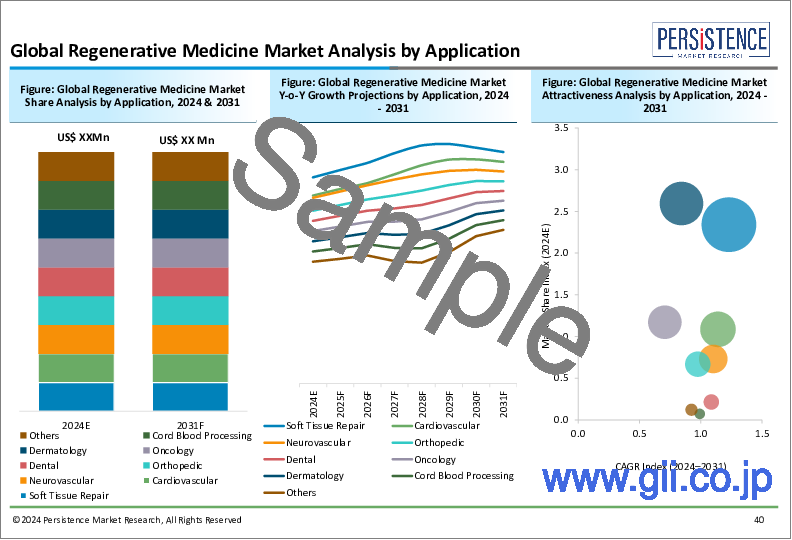
- 1.1. Global Regenerative Medicine Market Snapshot, 2024-2031
- 1.2. Market Opportunity Assessment, 2024-2031, US$ Mn
- 1.3. Key Market Trends
- 1.4. Future Market Projections
- 1.5. Premium Market Insights
- 1.6. Industry Developments and Key Market Events
- 1.7. PMR Analysis and Recommendations
2. Market Overview
- 2.1. Market Scope and Definition
- 2.2. Market Dynamics
- 2.2.1. Drivers
- 2.2.2. Restraints
- 2.2.3. Opportunity
- 2.2.4. Challenges
- 2.2.5. Key Trends
- 2.3. Macro-Economic Factors
- 2.3.1. Global Sectorial Outlook
- 2.3.2. Global GDP Growth Outlook
- 2.3.3. Global Healthcare Spending Outlook
- 2.4. COVID-19 Impact Analysis
- 2.5. Forecast Factors - Relevance and Impact
3. Value Added Insights
- 3.1. Product Adoption Analysis
- 3.2. Technology Assessment
- 3.3. Regulatory Landscape
- 3.4. Value Chain Analysis
- 3.4.1. List of Distribution Channel/Marketplaces
- 3.4.1.1. Retail
- 3.4.1.2. Audiology
- 3.4.1.3. E-Commerce
- 3.4.2. List of End User (Industry)
- 3.4.1. List of Distribution Channel/Marketplaces
- 3.5. Key Deals and Mergers
- 3.6. PESTLE Analysis
- 3.7. Porter's Five Force Analysis
4. Global Regenerative Medicine Market Outlook: Historical (2019-2023) and Forecast (2024-2031)
- 4.1. Key Highlights
- 4.1.1. Market Size (US$ Mn) and Y-o-Y Growth
- 4.1.2. Absolute $ Opportunity
- 4.2. Market Size (US$ Mn) Analysis and Forecast
- 4.2.1. Historical Market Size (US$ Mn) Analysis, 2019-2023
- 4.2.2. Current Market Size (US$ Mn) Analysis and Forecast, 2024-2031
- 4.3. Global Regenerative Medicine Market Outlook: Drug Type
- 4.3.1. Introduction / Key Findings
- 4.3.2. Historical Market Size (US$ Mn) Analysis, By Drug Type, 2019-2023
- 4.3.3. Current Market Size (US$ Mn) Analysis and Forecast, By Drug Type, 2024-2031
- 4.3.3.1. Antiplatelet Agents
- 4.3.3.2. Glycoprotein IIb/IIIa Inhibitors
- 4.3.3.3. Antithrombotic Agents
- 4.3.3.4. Beta-adrenergic Blockers
- 4.4. Market Attractiveness Analysis: Drug Type
- 4.5. Global Regenerative Medicine Market Outlook: Route of Administration
- 4.5.1. Introduction / Key Findings
- 4.5.2. Historical Market Size (US$ Mn) Analysis, By Route of Administration, 2019-2023
- 4.5.3. Current Market Size (US$ Mn) Analysis and Forecast, By Route of Administration, 2024-2031
- 4.5.3.1. Oral
- 4.5.3.2. Injectable
- 4.6. Market Attractiveness Analysis: Route of Administration
- 4.7. Global Regenerative Medicine Market Outlook: Distribution Channel
- 4.7.1. Introduction / Key Findings
- 4.7.2. Historical Market Size (US$ Mn) Analysis, By Distribution Channel, 2019-2023
- 4.7.3. Current Market Size (US$ Mn) Analysis and Forecast, By Distribution Channel, 2024-2031
- 4.7.3.1. Hospitals
- 4.7.3.2. Clinics
- 4.7.3.3. Retail Pharmacies
- 4.7.3.4. Online Pharmacies
- 4.8. Market Attractiveness Analysis: Distribution Channel
5. Global Regenerative Medicine Market Outlook: Region
- 5.1. Key Highlights
- 5.2. Historical Market Size (US$ Mn) Analysis, By Region, 2019-2023
- 5.3. Current Market Size (US$ Mn) Analysis and Forecast, By Region, 2024-2031
- 5.3.1. North America
- 5.3.2. Europe
- 5.3.3. East Asia
- 5.3.4. South Asia and Oceania
- 5.3.5. Latin America
- 5.3.6. Middle East & Africa
- 5.4. Market Attractiveness Analysis: Region
6. North America Regenerative Medicine Market Outlook: Historical (2019-2023) and Forecast (2024-2031)
- 6.1. Key Highlights
- 6.2. Pricing Analysis
- 6.3. Historical Market Size (US$ Mn) Analysis, By Market, 2019-2023
- 6.3.1. By Country
- 6.3.2. By Drug Type
- 6.3.3. By Route of Administration
- 6.3.4. By Distribution Channel
- 6.4. Current Market Size (US$ Mn) Analysis and Forecast, By Country, 2024-2031
- 6.4.1. U.S.
- 6.4.2. Canada
- 6.5. Current Market Size (US$ Mn) Analysis and Forecast, By Drug Type, 2024-2031
- 6.5.1. Antiplatelet Agents
- 6.5.2. Glycoprotein IIb/IIIa Inhibitors
- 6.5.3. Antithrombotic Agents
- 6.5.4. Beta-adrenergic Blockers
- 6.6. Current Market Size (US$ Mn) Analysis and Forecast, By Route of Administration, 2024-2031
- 6.6.1. Oral
- 6.6.2. Injectable
- 6.7. Current Market Size (US$ Mn) Analysis and Forecast, By Distribution Channel, 2024-2031
- 6.7.1. Hospitals
- 6.7.2. Clinics
- 6.7.3. Retail Pharmacies
- 6.7.4. Online Pharmacies
- 6.8. Market Attractiveness Analysis
7. Europe Regenerative Medicine Market Outlook: Historical (2019-2023) and Forecast (2024-2031)
- 7.1. Key Highlights
- 7.2. Pricing Analysis
- 7.3. Historical Market Size (US$ Mn) Analysis, By Market, 2019-2023
- 7.3.1. By Country
- 7.3.2. By Drug Type
- 7.3.3. By Route of Administration
- 7.3.4. By Distribution Channel
- 7.4. Current Market Size (US$ Mn) Analysis and Forecast, By Country, 2024-2031
- 7.4.1. Germany
- 7.4.2. France
- 7.4.3. U.K.
- 7.4.4. Italy
- 7.4.5. Spain
- 7.4.6. Russia
- 7.4.7. Turkiye
- 7.4.8. Rest of Europe
- 7.5. Current Market Size (US$ Mn) Analysis and Forecast, By Drug Type, 2024-2031
- 7.5.1. Antiplatelet Agents
- 7.5.2. Glycoprotein IIb/IIIa Inhibitors
- 7.5.3. Antithrombotic Agents
- 7.5.4. Beta-adrenergic Blockers
- 7.6. Current Market Size (US$ Mn) Analysis and Forecast, By Route of Administration, 2024-2031
- 7.6.1. Oral
- 7.6.2. Injectable
- 7.7. Current Market Size (US$ Mn) Analysis and Forecast, By Distribution Channel, 2024-2031
- 7.7.1. Hospitals
- 7.7.2. Clinics
- 7.7.3. Retail Pharmacies
- 7.7.4. Online Pharmacies
- 7.8. Market Attractiveness Analysis
8. East Asia Regenerative Medicine Market Outlook: Historical (2019-2023) and Forecast (2024-2031)
- 8.1. Key Highlights
- 8.2. Pricing Analysis
- 8.3. Historical Market Size (US$ Mn) Analysis, By Market, 2019-2023
- 8.3.1. By Country
- 8.3.2. By Drug Type
- 8.3.3. By Route of Administration
- 8.3.4. By Distribution Channel
- 8.4. Current Market Size (US$ Mn) Analysis and Forecast, By Country, 2024-2031
- 8.4.1. China
- 8.4.2. Japan
- 8.4.3. South Korea
- 8.5. Current Market Size (US$ Mn) Analysis and Forecast, By Drug Type, 2024-2031
- 8.5.1. Antiplatelet Agents
- 8.5.2. Glycoprotein IIb/IIIa Inhibitors
- 8.5.3. Antithrombotic Agents
- 8.5.4. Beta-adrenergic Blockers
- 8.6. Current Market Size (US$ Mn) Analysis and Forecast, By Route of Administration, 2024-2031
- 8.6.1. Oral
- 8.6.2. Injectable
- 8.7. Current Market Size (US$ Mn) Analysis and Forecast, By Distribution Channel, 2024-2031
- 8.7.1. Hospitals
- 8.7.2. Clinics
- 8.7.3. Retail Pharmacies
- 8.7.4. Online Pharmacies
- 8.8. Market Attractiveness Analysis
9. South Asia and Oceania Regenerative Medicine Market Outlook: Historical (2019-2023) and Forecast (2024-2031)
- 9.1. Key Highlights
- 9.2. Pricing Analysis
- 9.3. Historical Market Size (US$ Mn) Analysis, By Market, 2019-2023
- 9.3.1. By Country
- 9.3.2. By Drug Type
- 9.3.3. By Route of Administration
- 9.3.4. By Distribution Channel
- 9.4. Current Market Size (US$ Mn) Analysis and Forecast, By Country, 2024-2031
- 9.4.1. India
- 9.4.2. Southeast Asia
- 9.4.3. ANZ
- 9.4.4. Rest of South Asia & Oceania
- 9.5. Current Market Size (US$ Mn) Analysis and Forecast, By Drug Type, 2024-2031
- 9.5.1. Antiplatelet Agents
- 9.5.2. Glycoprotein IIb/IIIa Inhibitors
- 9.5.3. Antithrombotic Agents
- 9.5.4. Beta-adrenergic Blockers
- 9.6. Current Market Size (US$ Mn) Analysis and Forecast, By Route of Administration, 2024-2031
- 9.6.1. Oral
- 9.6.2. Injectable
- 9.7. Current Market Size (US$ Mn) Analysis and Forecast, By Distribution Channel, 2024-2031
- 9.7.1. Hospitals
- 9.7.2. Clinics
- 9.7.3. Retail Pharmacies
- 9.7.4. Online Pharmacies
- 9.8. Market Attractiveness Analysis
10. Latin America Regenerative Medicine Market Outlook: Historical (2019-2023) and Forecast (2024-2031)
- 10.1. Key Highlights
- 10.2. Pricing Analysis
- 10.3. Historical Market Size (US$ Mn) Analysis, By Market, 2019-2023
- 10.3.1. By Country
- 10.3.2. By Drug Type
- 10.3.3. By Route of Administration
- 10.3.4. By Distribution Channel
- 10.4. Current Market Size (US$ Mn) Analysis and Forecast, By Country, 2024-2031
- 10.4.1. Brazil
- 10.4.2. Mexico
- 10.4.3. Rest of Latin America
- 10.5. Current Market Size (US$ Mn) Analysis and Forecast, By Drug Type, 2024-2031
- 10.5.1. Antiplatelet Agents
- 10.5.2. Glycoprotein IIb/IIIa Inhibitors
- 10.5.3. Antithrombotic Agents
- 10.5.4. Beta-adrenergic Blockers
- 10.6. Current Market Size (US$ Mn) Analysis and Forecast, By Route of Administration, 2024-2031
- 10.6.1. Oral
- 10.6.2. Injectable
- 10.7. Current Market Size (US$ Mn) Analysis and Forecast, By Distribution Channel, 2024-2031
- 10.7.1. Hospitals
- 10.7.2. Clinics
- 10.7.3. Retail Pharmacies
- 10.7.4. Online Pharmacies
- 10.8. Market Attractiveness Analysis
11. Middle East & Africa Regenerative Medicine Market Outlook: Historical (2019-2023) and Forecast (2024-2031)
- 11.1. Key Highlights
- 11.2. Pricing Analysis
- 11.3. Historical Market Size (US$ Mn) Analysis, By Market, 2019-2023
- 11.3.1. By Country
- 11.3.2. By Drug Type
- 11.3.3. By Route of Administration
- 11.3.4. By Distribution Channel
- 11.4. Current Market Size (US$ Mn) Analysis and Forecast, By Country, 2024-2031
- 11.4.1. GCC Countries
- 11.4.2. Egypt
- 11.4.3. South Africa
- 11.4.4. Northern Africa
- 11.4.5. Rest of Middle East & Africa
- 11.5. Current Market Size (US$ Mn) Analysis and Forecast, By Drug Type, 2024-2031
- 11.5.1. Antiplatelet Agents
- 11.5.2. Glycoprotein IIb/IIIa Inhibitors
- 11.5.3. Antithrombotic Agents
- 11.5.4. Beta-adrenergic Blockers
- 11.6. Current Market Size (US$ Mn) Analysis and Forecast, By Route of Administration, 2024-2031
- 11.6.1. Oral
- 11.6.2. Injectable
- 11.7. Current Market Size (US$ Mn) Analysis and Forecast, By Distribution Channel, 2024-2031
- 11.7.1. Hospitals
- 11.7.2. Clinics
- 11.7.3. Retail Pharmacies
- 11.7.4. Online Pharmacies
- 11.8. Market Attractiveness Analysis
12. Competition Landscape
- 12.1. Market Share Analysis, 2024
- 12.2. Market Structure
- 12.2.1. Competition Intensity Mapping By Market
- 12.2.2. Competition Dashboard
- 12.3. Company Profiles (Details - Overview, Financials, Strategy, Recent Developments)
- 12.3.1. Bayer HealthCare LLC
- 12.3.1.1. Overview
- 12.3.1.2. Segments and Products
- 12.3.1.3. Key Financials
- 12.3.1.4. Market Developments
- 12.3.1.5. Market Strategy
- 12.3.2. Boehringer Ingelheim International GmbH
- 12.3.2.1. Overview
- 12.3.2.2. Segments and Products
- 12.3.2.3. Key Financials
- 12.3.2.4. Market Developments
- 12.3.2.5. Market Strategy
- 12.3.3. Eli Lilly and Company
- 12.3.3.1. Overview
- 12.3.3.2. Segments and Products
- 12.3.3.3. Key Financials
- 12.3.3.4. Market Developments
- 12.3.3.5. Market Strategy
- 12.3.4. Janssen Biotech, Inc.
- 12.3.4.1. Overview
- 12.3.4.2. Segments and Products
- 12.3.4.3. Key Financials
- 12.3.4.4. Market Developments
- 12.3.4.5. Market Strategy
- 12.3.5. Merck & Co. Inc.
- 12.3.5.1. Overview
- 12.3.5.2. Segments and Products
- 12.3.5.3. Key Financials
- 12.3.5.4. Market Developments
- 12.3.5.5. Market Strategy
- 12.3.6. Novartis International AG
- 12.3.6.1. Overview
- 12.3.6.2. Segments and Products
- 12.3.6.3. Key Financials
- 12.3.6.4. Market Developments
- 12.3.6.5. Market Strategy
- 12.3.7. Sanofi
- 12.3.7.1. Overview
- 12.3.7.2. Segments and Products
- 12.3.7.3. Key Financials
- 12.3.7.4. Market Developments
- 12.3.7.5. Market Strategy
- 12.3.8. AstraZeneca
- 12.3.8.1. Overview
- 12.3.8.2. Segments and Products
- 12.3.8.3. Key Financials
- 12.3.8.4. Market Developments
- 12.3.8.5. Market Strategy
- 12.3.9. Pfizer
- 12.3.9.1. Overview
- 12.3.9.2. Segments and Products
- 12.3.9.3. Key Financials
- 12.3.9.4. Market Developments
- 12.3.9.5. Market Strategy
- 12.3.10. Amgen, Inc
- 12.3.10.1. Overview
- 12.3.10.2. Segments and Products
- 12.3.10.3. Key Financials
- 12.3.10.4. Market Developments
- 12.3.10.5. Market Strategy
- 12.3.11. GlaxoSmithKline PLC
- 12.3.11.1. Overview
- 12.3.11.2. Segments and Products
- 12.3.11.3. Key Financials
- 12.3.11.4. Market Developments
- 12.3.11.5. Market Strategy
- 12.3.12. Regeneron Pharmaceuticals Inc.
- 12.3.12.1. Overview
- 12.3.12.2. Segments and Products
- 12.3.12.3. Key Financials
- 12.3.12.4. Market Developments
- 12.3.12.5. Market Strategy
- 12.3.13. Bristol-Myers Squibb Company
- 12.3.13.1. Overview
- 12.3.13.2. Segments and Products
- 12.3.13.3. Key Financials
- 12.3.13.4. Market Developments
- 12.3.13.5. Market Strategy
- 12.3.1. Bayer HealthCare LLC
13. Appendix
- 13.1. Research Methodology
- 13.2. Research Assumptions
- 13.3. Acronyms and Abbreviations