


食品用抗菌添加物:市場シェア分析、産業動向・統計、成長予測(2025年~2030年)
Food Antimicrobial Additives - Market Share Analysis, Industry Trends & Statistics, Growth Forecasts (2025 - 2030)

- 発行日
- ページ情報
- 英文 140 Pages
- 納期
- 2~3営業日
- 商品コード
- 1689796
- カスタマイズ可能 お客様のご希望に応じて、既存データの加工や未掲載情報(例:国別セグメント)の追加などの対応が可能です。詳細はお問い合わせください。
- 適宜更新あり 本レポートは最新情報反映のため適宜更新し、内容構成変更を行う場合があります。ご検討の際はお問い合わせください。
- 翻訳ツール提供対象 PDF対応AI翻訳ツールの無料貸し出しサービスのご利用が可能です
概要
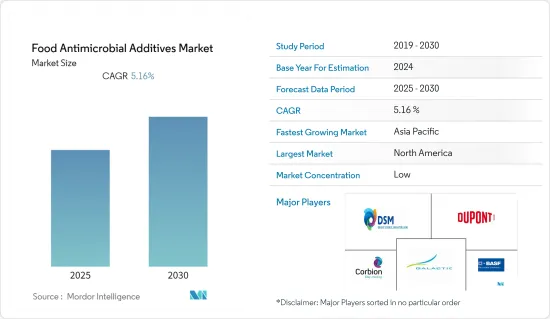
食品用抗菌添加物市場は予測期間中に5.16%のCAGRで推移すると予想されます。
COVID-19パンデミックは、抗菌添加物を生産するために利用される原材料の価格変動があったため、生産者に影響を与えました。このため、最終製品のコストに支障が生じた。飲食品は様々な病原菌や腐敗微生物によって汚染される可能性があり、前者は食中毒を引き起こし、後者は食品の特性に好ましくない影響を与えるため、食品産業に大きな経済的損失をもたらします。抗菌食品添加物は、食品中の微生物増殖を防止・抑制する上で重要な役割を果たしています。
しかし食肉業界では、その発がん性の影響から、あらゆる巨大・小規模生産者が亜硝酸塩の使用を厳格に停止しています。そのため、カビの繁殖を抑制するために、ナイシンやナタマイシンのような天然の抗菌添加物の使用が強化されています。
加工食品や食品の包装のような食品に接触する項目でまっすぐに利用抗菌添加物のための食品医薬品局(FDA)などの厳格な規制。これは予測期間中の市場成長を妨げると予測されます。これに加え、抗菌剤は現在、消費者が最も強く主張するフリーフロムの一つです。したがって、そのような抗菌剤の使用を排除するために飲食品メーカーをプッシュすることは、食品用抗菌添加物の全体市場の収益生成を直接妨げています。
食品用抗菌添加物市場の動向
食品の安全性と品質に対する消費者の関心の高まり
食品中の腐敗微生物の増殖は、最終製品の保存可能期間、食感特性、および全体的な品質に悪影響を及ぼすため、消費者の選択に影響を与え、重大な商業的損失をもたらします。このことは、食品の腐敗問題に緊急かつ注意深く取り組むべきことを浮き彫りにしています。さらに、食中毒の発生件数の増加、不純物の混入、毒性は、食品の安全性に対する脅威をますます顕在化させています。疾病管理予防センター(CDCP)は、毎年10人に1人が食中毒で病気になると報告しています。また、世界保健機関(WHO)の推計によると、食中毒の世界の負担は、毎年約12万5000人の子供が食中毒が原因で死亡しています。食品安全問題の高まりは、抗菌添加物の需要を促進すると予想されます。
北米が市場を独占
食品産業の成長により、同国では食品用抗菌添加物の需要が拡大しています。食酢、アスコルビン酸、ローズマリー、有機または天然物質由来の化学物質など、クリーンラベルの保存料や抗菌剤に対する需要が、市場の研究をさらに後押ししています。北米は、アスコルビン酸、酢、ローズマリー、および天然または有機要素から抽出された化学物質のようなクリーンラベルの抗菌剤や防腐剤の需要が市場をさらに押し上げるとして、食品用抗菌添加物市場を独占しました。そのため、メーカーは研究開発活動に投資し、クリーンラベルの抗菌剤を追加で導入することで、クリーンラベルの原料に対する需要の高まりに対応し、売上を伸ばしています。北米では、混沌として働くライフスタイル、都市化の進展、ホスピタリティや小売部門の成長により、飲食品や菓子類の需要が高まっており、食品用抗菌添加物の市場を牽引すると連続して予測されています。
食品用抗菌添加物産業の概要
食品用抗菌添加物市場は断片化されており、様々な活発なプレーヤーによって牽引されています。主要企業は、競争上の優位性を持つために、市場と製品範囲の拡大に注力しています。市場には、デュポン社、コルビオン社、DSM社、ギャラクティック社など多数の有力企業が存在します。同市場の大手企業は、幅広い地域で事業を展開し、多くの消費者の需要に応える幅広い製品ポートフォリオを有しています。この要素は、企業が市場で強力な足場を維持するのに役立っています。高度な流通ネットワークと製造の専門知識は、世界中に製品の範囲を拡大するためにメーカーに優位性を与えます。
その他の特典:
- エクセル形式の市場予測(ME)シート
- 3ヶ月間のアナリスト・サポート
目次
第1章 イントロダクション
- 調査の前提条件と市場定義
- 調査範囲
第2章 調査手法
第3章 エグゼクティブサマリー
第4章 市場力学
- 市場促進要因
- 市場抑制要因
- ポーターのファイブフォース分析
- 新規参入業者の脅威
- 買い手・消費者の交渉力
- 供給企業の交渉力
- 代替品の脅威
- 競争企業間の敵対関係の強さ
第5章 市場セグメンテーション
- タイプ別
- 天然
- ナイシン
- ナタマイシン
- 酢
- その他のタイプ
- 合成
- 安息香酸塩
- 亜硝酸塩
- ソルビン酸塩
- プロピオン酸塩
- 乳酸塩
- 酢酸塩
- その他のタイプ
- 天然
- 用途別
- ベーカリー・菓子類
- 乳製品
- スナック&セイボリー
- 飲料
- 肉・肉製品
- その他の用途
- 地域
- 北米
- 米国
- カナダ
- メキシコ
- その他北米地域
- 欧州
- スペイン
- 英国
- ドイツ
- フランス
- イタリア
- ロシア
- その他欧州
- アジア太平洋
- 中国
- 日本
- インド
- オーストラリア
- その他アジア太平洋地域
- 南米
- ブラジル
- アルゼンチン
- その他南米
- 中東・アフリカ
- サウジアラビア
- 南アフリカ
- その他中東とアフリカ
- 北米
第6章 競合情勢
- 最も活発な企業
- 最も採用されている戦略
- 市場シェア分析
- 企業プロファイル
- Koninklijke DSM NV
- The Archer Daniels Midland Company
- DuPont de Nemours Inc.
- Corbion NV
- Galactic
- BASF SE
- Jungbunzlauer Suisse AG
- Cargill Inc.
- International Flavors & Fragrances Inc.
- Celanese Corporation
第7章 市場機会と今後の動向
第8章 COVID-19が市場に与える影響
目次
The Food Antimicrobial Additives Market is expected to register a CAGR of 5.16% during the forecast period.
The COVID-19 pandemic impacted the producers as there was price fluctuation of raw materials that are utilized to produce antimicrobial additives. Owing to this, there was a hindrance in the cost of the end product. Food and beverage products can be contaminated by a variety of pathogens and spoilage microbiota, the former causing foodborne diseases and the latter causing significant economic losses for the food industry due to undesirable effects on the food properties. Antimicrobial food additives play an important role in the prevention and inhibition of microbial growth in food products.
However, in the meat industry, every giant and small-scale producer is rigorously suspending the utilization of nitrites due to their carcinogenic effect. This enhances the usage of natural antimicrobial additives, like nisin and natamycin, to inhibit mold growth.
Strict regulations such as the Food and Drug Administration (FDA) for antimicrobial additives utilized straightway in processed foods and food-contact items like the packaging of food. This is predicted to hinder the market growth during the forecast period. Adding to this, antimicrobials are one of the top free-from claims consumers nowadays. Thus, pushing the food and beverage product manufacturers to eliminate the use of such antimicrobials is directly hampering the revenue generation in the overall market for food antimicrobial additives.
Food Antimicrobials Additives Market Trends
Growing Consumer Interest in Food Safety and Quality
The growth of spoilage microbiota in food products negatively impacts the shelf-life, textural characteristics, and overall quality of the finished products, thus affecting consumer choices and resulting in significant commercial losses. This highlights the urgency and attention with which food spoilage issues should be addressed. Moreover, the rising number of foodborne disease outbreaks, adulteration cases, and toxicity have increasingly manifested the threat to food safety. The Centre for Disease Control and Prevention (CDCP) has reported that one in 10 people fall sick every year due to foodborne illness; most importantly, children under five years of age are at high risk. Also, according to World Health Organization (WHO) estimates, the global burden of foodborne diseases, around 125,000 children die every year because of foodborne illnesses. The growing food safety issues are expected to drive the demand for antimicrobial additives.
North America Dominates the Market
The growing food industry has extensively led to the demand for food antimicrobial additives in the country. The demand for clean-labeled preservatives and antimicrobials, such as vinegar, ascorbic acid, rosemary, and chemicals derived from organic or natural substances, further drives the market studied. North America dominated the food antimicrobial additives market as the demand for clean-labeled antimicrobials and preservatives like ascorbic acid, vinegar, rosemary, and chemicals extracted from natural or organic elements further boosts the market. Thus, manufacturers are investing in R&D activities to introduce clean-label antimicrobials with additional assets to boost sales by satiating the growing demand for clean-label ingredients. The rising demand for beverage and confectionery food products in North America due to the chaotic and working lifestyle, inflated urbanization, and growing hospitality and retail sector is consecutively predicted to drive the market for food antimicrobial additives.
Food Antimicrobials Additives Industry Overview
The food antimicrobial additives market is fragmented and is driven by various active players. The major players are focusing on expanding their market and product range to have a competitive advantage. There are numerous prominent players in the market, such as DuPont de Nemours Inc., Corbion NV, Koninklijke DSM NV, and Galactic. The major players in the market have a broad geographical presence and an extensive product portfolio to cater to numerous consumer demands. This factor assists the company in maintaining a strong foothold in the market. Advanced distribution network and manufacturing expertise give an upper edge to the manufacturers to expand their range of products across the world.
Additional Benefits:
- The market estimate (ME) sheet in Excel format
- 3 months of analyst support
TABLE OF CONTENTS
1 INTRODUCTION
- 1.1 Study Assumptions and Market Definition
- 1.2 Scope of the Study
2 RESEARCH METHODOLOGY
3 EXECUTIVE SUMMARY
4 MARKET DYNAMICS
- 4.1 Market Drivers
- 4.2 Market Restraints
- 4.3 Porter's Five Forces Analysis
- 4.3.1 Threat of New Entrants
- 4.3.2 Bargaining Power of Buyers/Consumers
- 4.3.3 Bargaining Power of Suppliers
- 4.3.4 Threat of Substitute Products
- 4.3.5 Intensity of Competitive Rivalry
5 MARKET SEGMENTATION
- 5.1 By Type
- 5.1.1 Natural
- 5.1.1.1 Nisin
- 5.1.1.2 Natamycin
- 5.1.1.3 Vinegar
- 5.1.1.4 Other Types
- 5.1.2 Synthetic
- 5.1.2.1 Benzoates
- 5.1.2.2 Nitrites
- 5.1.2.3 Sorbates
- 5.1.2.4 Propionates
- 5.1.2.5 Lactates
- 5.1.2.6 Acetates
- 5.1.2.7 Other Types
- 5.1.1 Natural
- 5.2 By Application
- 5.2.1 Bakery and Confectionery
- 5.2.2 Dairy Products
- 5.2.3 Snacks and Savory
- 5.2.4 Beverages
- 5.2.5 Meat and Meat Products
- 5.2.6 Other Applications
- 5.3 Geography
- 5.3.1 North America
- 5.3.1.1 United States
- 5.3.1.2 Canada
- 5.3.1.3 Mexico
- 5.3.1.4 Rest of North America
- 5.3.2 Europe
- 5.3.2.1 Spain
- 5.3.2.2 United Kingdom
- 5.3.2.3 Germany
- 5.3.2.4 France
- 5.3.2.5 Italy
- 5.3.2.6 Russia
- 5.3.2.7 Rest of Europe
- 5.3.3 Asia-Pacific
- 5.3.3.1 China
- 5.3.3.2 Japan
- 5.3.3.3 India
- 5.3.3.4 Australia
- 5.3.3.5 Rest of Asia-Pacific
- 5.3.4 South America
- 5.3.4.1 Brazil
- 5.3.4.2 Argentina
- 5.3.4.3 Rest of South America
- 5.3.5 Middle East & Africa
- 5.3.5.1 Saudi Arabia
- 5.3.5.2 South Africa
- 5.3.5.3 Rest of Middle East & Africa
- 5.3.1 North America
6 COMPETITIVE LANDSCAPE
- 6.1 Most Active Companies
- 6.2 Most Adopted Strategies
- 6.3 Market Share Analysis
- 6.4 Company Profiles
- 6.4.1 Koninklijke DSM NV
- 6.4.2 The Archer Daniels Midland Company
- 6.4.3 DuPont de Nemours Inc.
- 6.4.4 Corbion NV
- 6.4.5 Galactic
- 6.4.6 BASF SE
- 6.4.7 Jungbunzlauer Suisse AG
- 6.4.8 Cargill Inc.
- 6.4.9 International Flavors & Fragrances Inc.
- 6.4.10 Celanese Corporation
7 MARKET OPPORTUNITIES AND FUTURE TRENDS
8 IMPACT OF COVID-19 ON THE MARKET
- 発行日
- 発行
- Mordor Intelligence
- ページ情報
- 英文 140 Pages
- 納期
- 2~3営業日


