
デフォルト表紙
市場調査レポート
商品コード
1666994

フレキシブル電線管市場の機会、成長促進要因、産業動向分析、2025~2034年の予測

Flexible Electrical Conduit Market Opportunity, Growth Drivers, Industry Trend Analysis, and Forecast 2025 - 2034


出版日
ページ情報
英文 100 Pages
納期
2~3営業日
カスタマイズ可能
フレキシブル電線管市場の機会、成長促進要因、産業動向分析、2025~2034年の予測
出版日: 2024年12月03日
発行: Global Market Insights Inc.
ページ情報: 英文 100 Pages
納期: 2~3営業日
GIIご利用のメリット
  • 全表示

  • 概要
  • 目次
概要

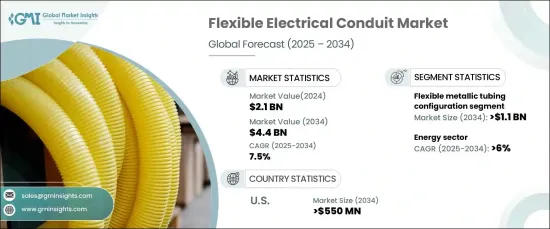
世界のフレキシブル電線管市場は2024年に21億米ドルに達し、2025年から2034年にかけてCAGR 7.5%で成長すると予測されています。

この成長は、建設、自動車、通信など、耐久性と適応性に優れたソリューションが不可欠な産業における需要の高まりによるものです。都市化の進展、インフラの進歩、自動化の導入が、配線システムを効果的に保護するフレキシブル導管の必要性をさらに高めています。
Flexible Electrical Conduit Market-IMG1

フレキシブル金属管(FMT)分野は、汎用性が高く設置が容易なソリューションへの需要に後押しされ、2034年までに11億米ドルの売上が見込まれています。顧客が産業オートメーションに合わせた耐火性や高柔軟性の電線管など、特殊なオプションを求めるようになり、カスタマイズが極めて重要な動向となっています。モジュール式や組み立て済みのコンフィギュレーションの出現により、設置プロセスが簡素化され、人件費が削減され、全体的な効率が向上しています。さらに、安全性と規制遵守への関心の高まりが、厳しい業界基準を満たす革新的な設計への投資に拍車をかけています。

市場範囲
開始年 2024
予測年 2025-2034
開始金額 21億米ドル
予測金額 44億米ドル
CAGR 7.5%

フレキシブル電線管市場は、2034年までのCAGRが6%と、エネルギー分野が大きく成長する見通しです。風力発電や太陽光発電を含む再生可能エネルギー・プロジェクトへの注目の高まりが、効率的で安全な配線システムのためのフレキシブル導管の採用を促進しています。さらに、スマートグリッドインフラの拡大とエネルギー効率の高い技術の統合が進んでいることも、エネルギー配給網におけるフレキシブル導管の需要を押し上げています。こうしたニーズに対応するため、メーカーは安全性、コンプライアンス、環境の持続可能性を優先した先進的な電線管ソリューションを開発しています。

米国のフレキシブル電線管市場は、2034年までに5億5,000万米ドルを生み出すと予測されています。成長の促進要因となっているのは、建設、製造、エネルギーなどの業界からの旺盛な需要です。建築物におけるスマート技術と自動化の統合により、耐久性と耐火性に優れたフレキシブル導管へのニーズが高まっています。さらに、安全性と環境コンプライアンスに焦点を当てた規制要件の進化が、環境に優しく高性能な電線管ソリューションの開発をメーカーに促しています。

全体として、フレキシブル電線管市場は、多様な分野にわたって信頼性が高く、安全で効率的な配線ソリューションへのニーズが高まっているため、着実な成長を遂げています。カスタマイズ、規制順守、技術革新を重視することで、急速に進化する世界のインフラ状況の需要に対応し、市場をさらに推進することが期待されます。

目次

第1章 調査手法と調査範囲

  • 市場の定義
  • 基本推定と計算
  • 予測計算
  • データソース
    • 1次データ
    • 2次データ
      • 有償
      • 公的

第2章 エグゼクティブサマリー

第3章 業界洞察

  • エコシステム分析
  • 規制状況
  • 業界への影響要因
    • 促進要因
    • 業界の潜在的リスク&課題
  • 成長可能性分析
  • ポーターの分析
    • 供給企業の交渉力
    • 買い手の交渉力
    • 新規参入業者の脅威
    • 代替品の脅威
  • PESTEL分析

第4章 競合情勢

  • 戦略ダッシュボード
  • イノベーションと持続可能性の展望

第5章 市場規模・予測:取引規模別、2021年~2034年

  • 主要動向
  • 1/2~1
  • 1 1/4~2
  • 2 1/2~3
  • 3~4
  • 5~6
  • その他

第6章 市場規模・予測:構成別、2021年~2034年

  • 主要動向
  • フレキシブルメタリック(FMC)
  • 液密フレキシブルメタル(LFMC)
  • フレキシブメタリック・チューブ(FMT)
  • 液密フレキシブル非金属(LFNC)

第7章 市場規模・予測:用途別、2021年~2034年

  • 主要動向
  • 鉄道インフラ
  • 軍事航空宇宙
  • 医療施設
  • プロセスプラント
  • エネルギー
  • その他

第8章 市場規模・予測:最終用途別、2021年~2034年

  • 主要動向
  • 住宅用
  • 商業用
  • 産業用
  • ユーティリティ

第9章 市場規模・予測:地域別、2021年~2034年

  • 主要動向
  • 北米
    • 米国
    • カナダ
    • メキシコ
  • 欧州
    • フランス
    • ドイツ
    • イタリア
    • 英国
    • ロシア
  • アジア太平洋
    • 中国
    • インド
    • 日本
    • 韓国
    • オーストラリア
  • 中東・アフリカ
    • サウジアラビア
    • アラブ首長国連邦
    • カタール
    • 南アフリカ
  • ラテンアメリカ
    • ブラジル
    • アルゼンチン

第10章 企業プロファイル

  • ABB
  • Anamet Electrical
  • Atkore
  • CANTEX
  • Dongguan FlexGlory Machinery Accessories
  • Electri-Flex Company
  • Hubbell
  • HellermannTyton
  • Kaiphone Technology
  • Legrand
  • Schneider Electric
  • Southwire Company
  • Wienerberger
目次
Product Code: 5923

The Global Flexible Electrical Conduit Market reached USD 2.1 billion in 2024 and is projected to grow at a CAGR of 7.5% during 2025-2034. This growth is attributed to rising demand across industries such as construction, automotive, and telecommunications, where durable and adaptable solutions are essential. Increasing urbanization, infrastructure advancements, and the adoption of automation are further driving the need for flexible conduits to safeguard wiring systems effectively.

Flexible Electrical Conduit Market - IMG1

The flexible metallic tubing (FMT) segment is expected to generate USD 1.1 billion through 2034, fueled by the demand for versatile, easy-to-install solutions. Customization has become a pivotal trend as clients seek specialized options like fire-resistant or high-flexibility conduits tailored for industrial automation. The emergence of modular and pre-assembled configurations is simplifying installation processes, reducing labor expenses, and enhancing overall efficiency. Moreover, growing attention to safety and regulatory compliance has spurred investments in innovative designs that meet stringent industry standards.

Market Scope
Start Year2024
Forecast Year2025-2034
Start Value$2.1 Billion
Forecast Value$4.4 Billion
CAGR7.5%

The energy sector is poised for significant growth in the flexible electrical conduit market, with a CAGR of 6% through 2034. The rising focus on renewable energy projects, including wind and solar installations, is driving the adoption of flexible conduits for efficient and secure wiring systems. Additionally, the expansion of smart grid infrastructure and the increasing integration of energy-efficient technologies are boosting demand for flexible conduits in energy distribution networks. To address these needs, manufacturers are developing advanced conduit solutions that prioritize safety, compliance, and environmental sustainability.

U.S. flexible electrical conduit market is projected to generate USD 550 million by 2034. Growth is being driven by robust demand from industries such as construction, manufacturing, and energy. The integration of smart technologies and automation in buildings has heightened the need for durable and fire-resistant flexible conduits. Furthermore, evolving regulatory requirements focused on safety and environmental compliance are pushing manufacturers to create environment-friendly, high-performance conduit solutions.

Overall, the flexible electrical conduit market is experiencing steady growth due to the increasing need for reliable, safe, and efficient wiring solutions across diverse sectors. Emphasis on customization, regulatory adherence, and innovation is expected to further propel the market, catering to the demands of a rapidly evolving global infrastructure landscape.

Table of Contents

Chapter 1 Methodology & Scope

  • 1.1 Market definitions
  • 1.2 Base estimates & calculations
  • 1.3 Forecast calculation
  • 1.4 Data sources
    • 1.4.1 Primary
    • 1.4.2 Secondary
      • 1.4.2.1 Paid
      • 1.4.2.2 Public

Chapter 2 Executive Summary

  • 2.1 Industry synopsis, 2021 - 2034

Chapter 3 Industry Insights

  • 3.1 Industry ecosystem analysis
  • 3.2 Regulatory landscape
  • 3.3 Industry impact forces
    • 3.3.1 Growth drivers
    • 3.3.2 Industry pitfalls & challenges
  • 3.4 Growth potential analysis
  • 3.5 Porter's analysis
    • 3.5.1 Bargaining power of suppliers
    • 3.5.2 Bargaining power of buyers
    • 3.5.3 Threat of new entrants
    • 3.5.4 Threat of substitutes
  • 3.6 PESTEL analysis

Chapter 4 Competitive Landscape, 2024

  • 4.1 Strategic dashboard
  • 4.2 Innovation & sustainability landscape

Chapter 5 Market Size and Forecast, By Trade Size, 2021 – 2034 (USD Million)

  • 5.1 Key trends
  • 5.2 ½ to 1
  • 5.3 1 ¼ to 2
  • 5.4 2 ½ to 3
  • 5.5 3 to 4
  • 5.6 5 to 6
  • 5.7 Others

Chapter 6 Market Size and Forecast, By Configuration, 2021 – 2034 (USD Million)

  • 6.1 Key trends
  • 6.2 Flexible Metallic (FMC)
  • 6.3 Liquid-Tight Flexible Metal (LFMC)
  • 6.4 Flexible Metallic Tubing (FMT)
  • 6.5 Liquid-Tight Flexible Non-Metallic (LFNC)

Chapter 7 Market Size and Forecast, By Application, 2021 – 2034 (USD Million)

  • 7.1 Key trends
  • 7.2 Rail infrastructure
  • 7.3 Military aerospace
  • 7.4 Healthcare facilities
  • 7.5 Process plants
  • 7.6 Energy
  • 7.7 Others

Chapter 8 Market Size and Forecast, By End Use, 2021 – 2034 (USD Million)

  • 8.1 Key trends
  • 8.2 Residential
  • 8.3 Commercial
  • 8.4 Industrial
  • 8.5 Utility

Chapter 9 Market Size and Forecast, By Region, 2021 – 2034 (USD Million)

  • 9.1 Key trends
  • 9.2 North America
    • 9.2.1 U.S.
    • 9.2.2 Canada
    • 9.2.3 Mexico
  • 9.3 Europe
    • 9.3.1 France
    • 9.3.2 Germany
    • 9.3.3 Italy
    • 9.3.4 UK
    • 9.3.5 Russia
  • 9.4 Asia Pacific
    • 9.4.1 China
    • 9.4.2 India
    • 9.4.3 Japan
    • 9.4.4 South Korea
    • 9.4.5 Australia
  • 9.5 Middle East & Africa
    • 9.5.1 Saudi Arabia
    • 9.5.2 UAE
    • 9.5.3 Qatar
    • 9.5.4 South Africa
  • 9.6 Latin America
    • 9.6.1 Brazil
    • 9.6.2 Argentina

Chapter 10 Company Profiles

  • 10.1 ABB
  • 10.2 Anamet Electrical
  • 10.3 Atkore
  • 10.4 CANTEX
  • 10.5 Dongguan FlexGlory Machinery Accessories
  • 10.6 Electri-Flex Company
  • 10.7 Hubbell
  • 10.8 HellermannTyton
  • 10.9 Kaiphone Technology
  • 10.10 Legrand
  • 10.11 Schneider Electric
  • 10.12 Southwire Company
  • 10.13 Wienerberger