


パーティクルボードの市場機会、成長促進要因、産業動向分析、2024年~2032年予測
Particle Board Market Opportunity, Growth Drivers, Industry Trend Analysis, and Forecast 2024 - 2032


- 発行日
- ページ情報
- 英文 220 Pages
- 納期
- 2~3営業日
- 商品コード
- 1664861
- カスタマイズ可能 お客様のご希望に応じて、既存データの加工や未掲載情報(例:国別セグメント)の追加などの対応が可能です。詳細はお問い合わせください。
- 翻訳ツール提供対象 PDF対応AI翻訳ツールの無料貸し出しサービスのご利用が可能です
概要
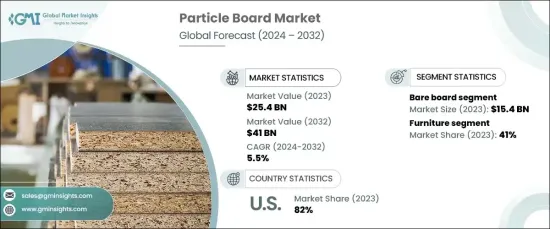
パーティクルボードの世界市場は、2023年に254億米ドルとなり、2024年から2032年にかけて5.5%のCAGRで堅調に成長すると予測されています。
この成長の原動力となっているのは、経済的、社会的、技術的進歩による様々な分野での需要の増加です。
市場拡大の主な促進要因のひとつは、特に発展地域で急成長している家具産業です。都市化と中産階級の増加により、手頃な価格で機能的な家具に対する需要が生まれています。コスト効率と汎用性で知られるパーティクルボードは、組み立て式(RTA)家具、キャビネット、収納ソリューションの製造に広く使用されています。その手頃な価格と適応性により、消費者にも製造業者にも好まれる選択肢となっています。
| 市場範囲 | |
|---|---|
| 開始年 | 2023年 |
| 予測年 | 2024年~2032年 |
| 開始金額 | 254億米ドル |
| 予測金額 | 410億米ドル |
| CAGR | 5.5% |
市場は、ベアボードとラミネートボードの2つの主要セグメントに分けられます。ベアボードセグメントは2023年に154億米ドルを生み出し、2032年までCAGR5.7%で成長すると予測されます。ベアボードは製造コストが低いため、予算に見合ったソリューションを重視する産業や消費者にとって魅力的な選択肢となっています。これらのボードは、その実用性と費用対効果の高さから、手頃な価格の住宅プロジェクト、建設、家具生産で一般的に使用されています。
用途に関しては、パーティクルボード市場は家具、キャビネット、フローリング、ドア、天井パネル、壁材、包装など様々な業界にまたがっています。家具分野は2023年に41%の圧倒的シェアを占め、2024年から2032年まで5.7%の成長率を維持すると予測されています。手頃な価格で大量生産に適していることから、パーティクルボードは、都市部におけるスタイリッシュかつ手頃な価格の家具に対する需要の高まりに応えようとする家具メーカーにとって、頼りになる材料となっています。
米国では、パーティクルボード市場は2023年に82%の大きなシェアを占めました。大都市における都市化と住宅需要の高まりにより、費用対効果の高い建設資材のニーズが高まっています。住宅価格が上昇を続ける中、パーティクルボードは無垢材や合板のような高価な材料に代わる実用的な代替品となっており、床下地、壁、その他の構造要素に応用されています。
目次
第1章 調査手法と調査範囲
- 市場範囲と定義
- 基本推定と計算
- 予測計算
- データソース
- 一次
- 二次
- 有料情報源
- 公的情報源
第2章 エグゼクティブサマリー
第3章 業界洞察
- 業界エコシステム分析
- バリューチェーンに影響を与える要因
- 利益率分析
- 変革
- 将来の展望
- メーカー
- 流通業者
- サプライヤーの状況
- 利益率分析
- 主要ニュース・イニシアチブ
- 規制状況
- 影響要因
- 成長促進要因
- 建設活動の増加
- 家具市場の成長
- 業界の潜在的リスク・課題
- 市場の飽和と競争の激化
- 持続可能性への懸念
- 成長促進要因
- 成長可能性分析
- ポーター分析
- PESTEL分析
第4章 競合情勢
- イントロダクション
- 企業市場シェア分析
- 競合のポジショニングマトリックス
- 戦略展望マトリックス
第5章 市場推計・予測:製品タイプ別、2021年~2032年
- 主要動向
- ベアボード
- 単層パーティクルボード
- 3層パーティクルボード
- 傾斜密度パーティクルボード
- セメント接着パーティクルボード
- その他
- 積層パーティクルボード
- ベニヤパーティクルボード
- メラミンパーティクルボード
- その他
第6章 市場推計・予測:用途別、2021年~2032年
- 主要動向
- 家具
- フローリング
- キャビネット
- ドア
- 壁材
- 天井パネル
- 包装
- その他(カウンタートップ、シャッターなど)
第7章 市場推計・予測:最終用途別、2021年~2032年
- 主要動向
- 住宅用
- 商業用
- 産業用
第8章 市場推計・予測:流通チャネル別、2021年~2032年
- 主要動向
- 直接
- 間接
第9章 市場推計・予測:地域別、2021年~2032年
- 主要動向
- 北米
- 米国
- カナダ
- 欧州
- 英国
- ドイツ
- フランス
- イタリア
- スペイン
- ロシア
- アジア太平洋
- 中国
- インド
- 日本
- 韓国
- オーストラリア
- ラテンアメリカ
- ブラジル
- メキシコ
- 中東・アフリカ
- UAE
- サウジアラビア
- 南アフリカ
第10章 企業プロファイル
- Arauco
- Daewon Industrial
- Duratex
- Egger Group
- Finsa
- Georgia-Pacific
- Homanit
- Kastamonu Entegre
- Kronospan
- Masonite
- Nelson Pine
- Pfleiderer
- Sumitomo Forestry
- Swedish Wood
- Uniboard
目次
The Global Particle Board Market, valued at USD 25.4 billion in 2023, is projected to grow at a robust CAGR of 5.5% from 2024 to 2032. This growth is fueled by increasing demand across various sectors, driven by economic, societal, and technological advancements.
One of the primary drivers of this market expansion is the rapidly growing furniture industry, particularly in developing regions. Urbanization and the rising middle class are creating a demand for affordable, functional furniture. Particle board, known for its cost-efficiency and versatility, is widely used in manufacturing ready-to-assemble (RTA) furniture, cabinets, and storage solutions. Its affordability and adaptability make it the preferred choice for both consumers and manufacturers alike.
| Market Scope | |
|---|---|
| Start Year | 2023 |
| Forecast Year | 2024-2032 |
| Start Value | $25.4 billion |
| Forecast Value | $41 billion |
| CAGR | 5.5% |
The market is divided into two major segments: bare and laminated boards. The bare board segment generated USD 15.4 billion in 2023 and is expected to grow at a CAGR of 5.7% through 2032. The low production cost of bare boards makes them an attractive option for industries and consumers focused on budget-friendly solutions. These boards are commonly used in affordable housing projects, construction, and furniture production due to their practicality and cost-effectiveness.
When it comes to applications, the particle board market spans various industries, including furniture, cabinets, flooring, doors, ceiling panels, wall cladding, and packaging. The furniture sector held a dominant 41% share in 2023 and is projected to maintain a growth rate of 5.7% from 2024 to 2032. The combination of affordability and suitability for mass production makes particle boards a go-to material for furniture manufacturers seeking to meet the rising demand for stylish yet affordable furniture in urban areas.
In the U.S., the particle board market accounted for a significant 82% share in 2023. Urbanization and growing housing demands in major cities have led to an increase in the need for cost-effective construction materials. As home prices continue to rise, particle board has become a practical alternative to more expensive materials like solid wood and plywood, with applications in subflooring, walls, and other structural elements.
Table of Contents
Chapter 1 Methodology & Scope
- 1.1 Market scope & definitions
- 1.2 Base estimates & calculations
- 1.3 Forecast calculations.
- 1.4 Data sources
- 1.4.1 Primary
- 1.4.2 Secondary
- 1.4.2.1 Paid sources
- 1.4.2.2 Public sources
Chapter 2 Executive Summary
- 2.1 Industry synopsis, 2021-2032
Chapter 3 Industry Insights
- 3.1 Industry ecosystem analysis
- 3.1.1 Factor affecting the value chain.
- 3.1.2 Profit margin analysis.
- 3.1.3 Disruptions
- 3.1.4 Future outlook
- 3.1.5 Manufacturers
- 3.1.6 Distributors
- 3.2 Supplier landscape
- 3.3 Profit margin analysis.
- 3.4 Key news & initiatives
- 3.5 Regulatory landscape
- 3.6 Impact forces
- 3.6.1 Growth drivers
- 3.6.1.1 Increasing construction activities
- 3.6.1.2 Growing furniture market
- 3.6.2 Industry pitfalls & challenges
- 3.6.2.1 Market saturation and intense competition
- 3.6.2.2 Sustainability concerns
- 3.6.1 Growth drivers
- 3.7 Growth potential analysis
- 3.8 Porter’s analysis
- 3.9 PESTEL analysis
Chapter 4 Competitive Landscape, 2023
- 4.1 Introduction
- 4.2 Company market share analysis
- 4.3 Competitive positioning matrix
- 4.4 Strategic outlook matrix
Chapter 5 Market Estimates & Forecast, By Product Type, 2021-2032 (USD Billion) (Thousand Square Feet)
- 5.1 Key trends
- 5.2 Bare board
- 5.2.1 Single-layer particle board
- 5.2.2 Three-layer particle board
- 5.2.3 Graded-density particle board
- 5.2.4 Cement-bonded particle board
- 5.2.5 Others
- 5.3 Laminated particle board
- 5.3.1 Veneered particle board
- 5.3.2 Melamine particle board
- 5.3.3 Others
Chapter 6 Market Estimates & Forecast, By Application, 2021-2032 (USD Billion) (Thousand Square Feet)
- 6.1 Key trends
- 6.2 Furniture
- 6.3 Flooring
- 6.4 Cabinets
- 6.5 Doors
- 6.6 Wall cladding
- 6.7 Ceiling panels
- 6.8 Packaging
- 6.9 Others (countertop, shutter, etc.)
Chapter 7 Market Estimates & Forecast, By End-use, 2021-2032 (USD Billion) (Thousand Square Feet)
- 7.1 Key trends
- 7.2 Residential
- 7.3 Commercial
- 7.4 Industrial
Chapter 8 Market Estimates & Forecast, By Distribution Channel, 2021-2032 (USD Billion) (Thousand Square Feet)
- 8.1 Key trends
- 8.2 Direct
- 8.3 Indirect
Chapter 9 Market Estimates & Forecast, By Region, 2021-2032 (USD Billion) (Thousand Square Feet)
- 9.1 Key trends
- 9.2 North America
- 9.2.1 U.S.
- 9.2.2 Canada
- 9.3 Europe
- 9.3.1 UK
- 9.3.2 Germany
- 9.3.3 France
- 9.3.4 Italy
- 9.3.5 Spain
- 9.3.6 Russia
- 9.4 Asia Pacific
- 9.4.1 China
- 9.4.2 India
- 9.4.3 Japan
- 9.4.4 South Korea
- 9.4.5 Australia
- 9.5 Latin America
- 9.5.1 Brazil
- 9.5.2 Mexico
- 9.6 MEA
- 9.6.1 UAE
- 9.6.2 Saudi Arabia
- 9.6.3 South Africa
Chapter 10 Company Profiles
- 10.1 Arauco
- 10.2 Daewon Industrial
- 10.3 Duratex
- 10.4 Egger Group
- 10.5 Finsa
- 10.6 Georgia-Pacific
- 10.7 Homanit
- 10.8 Kastamonu Entegre
- 10.9 Kronospan
- 10.10 Masonite
- 10.11 Nelson Pine
- 10.12 Pfleiderer
- 10.13 Sumitomo Forestry
- 10.14 Swedish Wood
- 10.15 Uniboard
- 発行日
- 発行
- Global Market Insights Inc.
- ページ情報
- 英文 220 Pages
- 納期
- 2~3営業日


