|
市場調査レポート
商品コード
1494891
アンチドローン市場の2030年までの予測:タイプ別、ミティゲーションタイプ別、技術別、用途別、エンドユーザー別、地域別の世界分析Anti Drone Market Forecasts to 2030 - Global Analysis By Type (Ground Based, UAV Based, Handheld and Other Types), Mitigation Type, Technology, Application, End User and By Geography |
||||||
|
|
|||||||
カスタマイズ可能
|
|||||||
| アンチドローン市場の2030年までの予測:タイプ別、ミティゲーションタイプ別、技術別、用途別、エンドユーザー別、地域別の世界分析 |
|
出版日: 2024年06月06日
発行: Stratistics Market Research Consulting
ページ情報: 英文 200+ Pages
納期: 2~3営業日
|
全表示
- 概要
- 図表
- 目次
Stratistics MRCによると、世界のアンチドローン市場は、2024年に31億米ドルを占め、予測期間中にCAGR 31.6%で成長し、2030年には161億米ドルに達すると予測されています。
アンチドローンとは、無許可または敵対的なドローンを検出、追跡、軽減、無力化するために設計されたシステムまたは対策です。これらのシステムは、無許可の監視、密輸、悪意のある攻撃など、ドローンがもたらす潜在的な脅威から、空港、政府ビル、軍事施設、公共イベント、重要インフラストラクチャなどの機密エリアを保護するために利用されます。ドローン対策技術には、レーダーシステム、無線周波数(RF)探知機、妨害装置、ネットガン、レーザー、さらには訓練された猛禽類などがあります。ドローン対策の目的は、ドローンが危険や混乱をもたらす可能性のある地域において、安全、セキュリティ、プライバシーを確保することです。
米国陸軍協会によると、テロリスト集団は、情報収集、爆発物の運搬、化学兵器の運搬など、さまざまな目的で空飛ぶドローンを利用したり、利用しようとしたりしています。FAA(米連邦航空局)は2020年、パイロットの目視外でのドローンの商業利用を許可しました。
ドローンの利用拡大
市場では、ドローンそのもの利用が急増しています。他のドローンに対抗するためにドローンを採用することは、逆説的だが効果的なアプローチを提示します。これらのアンチドローン用ドローンは、AI、機械学習、コンピュータビジョンなどの先進技術を搭載しており、無許可のドローンを検知、追跡、無力化します。この動向は、アンチドローン戦略の進化を浮き彫りにしており、テクノロジーに対抗するためのテクノロジーの利用がますます広まっています。
複雑な規制
厳しい規制のため、市場をナビゲートすることは複雑さを伴う。技術的能力の進化に伴い、当局は継続的に政策を改定し、メーカーとユーザーの双方に複雑なレイヤーを追加しています。登録、ライセンシング、制限空域指定などのコンプライアンス要件は地域によって異なるため、世界な事業展開には大きな課題となります。その結果、利害関係者は、この入り組んだ規制環境の中で、法令遵守と効果的な対策展開の両方を確保するために、常に用心深く機敏に行動する必要があります。
技術の進歩
技術革新には、雑然とした環境の中でドローンのシグネチャーを識別できるAI主導の検知システムが含まれます。対策ソリューションは、指向性エネルギー兵器や電子戦技術によって進化し、正確かつ非致死的な無力化手段を提供しています。機械学習アルゴリズムの統合により対応能力が強化され、効果的な軽減戦略のためのリアルタイムの意思決定が可能になります。さらに、ドローンジャミングとスプーフィング技術の進歩により、悪意あるドローンの侵入に対する防御が強化されています。
限られた社会的認識
不正なドローンがもたらす脅威が増大しているにもかかわらず、多くの個人や組織は、利用可能な対策を知らないままです。この認識不足がドローン対策技術の採用を妨げ、市場の成長を阻害しています。この課題に対処するには、教育とアウトリーチにおける協調的な取り組みが必要であり、空域の完全性とプライバシーの保護における積極的なドローン防衛対策の重要性を強調する必要があります。一般市民の意識の向上は、需要を促進し、この分野の技術革新に拍車をかけることができます。
COVID-19の影響:
COVID-19パンデミックはアンチドローン市場に大きな影響を与え、当初は封鎖措置や労働力不足によりサプライチェーンや製造工程に混乱が生じた。しかし、この危機はセキュリティの脆弱性に対する意識の高まりにもつながり、重要なインフラ、イベント、空域を保護するためのアンチドローンソリューションの需要を促進しました。同市場では、社会的距離を置くための遠隔監視や自律システムの採用が急増しました。
予測期間中、中和セグメントが最大になる見込み
予測期間中、中和分野が最大となる見込み。中和技術はアンチドローン市場において極めて重要であり、無許可のドローン活動に対する効果的な対策を提供します。これらのソリューションは、信号妨害、レーザーシステム、物理的傍受方法など、様々なアプローチを包含しています。信号妨害は、ドローンの通信と制御を妨害し、不活性化させるか、安全な着陸に誘導します。レーザーシステムは、重要な部品をターゲットにすることでドローンを無力化します。
予測期間中、刑務所セグメントのCAGRが最も高くなると予測されています。
刑務所分野は予測期間中、最も高いCAGRが見込まれています。ドローンが禁制品の密輸や監視などの違法活動に使用される脅威が高まる中、刑務所は施設を保護するための対策に投資しています。これには、ドローン検知システム、シグナルジャマー、さらにはドローンを迎撃するための訓練された猛禽類の配備が含まれます。こうした対策は、セキュリティを強化し、刑務所空域への無許可のドローン侵入を防ぎ、矯正施設の安全性と完全性を確保することを目的としています。
最大のシェアを占める地域
北米は、セキュリティへの懸念の高まりとドローン技術の進歩により、予測期間中最大の市場シェアを占めると予測されています。機密空域への無許可のドローン侵入事件の増加に伴い、アンチドローンシステムの需要が急増しています。主要企業は、ドローンの脅威を効果的に軽減するために、妨害、迎撃、検知などの技術革新を進めています。政府の規制や防衛・重要インフラ分野への投資が市場拡大をさらに後押しし、同地域はアンチドローンソリューションの重要な拠点となっています。
CAGRが最も高い地域:
予測期間中、アジア太平洋地域が最も高いCAGRを維持すると予測されています。技術の急速な進歩は、不正なドローンを検出、追跡、無力化することができる洗練されたアンチドローンシステムの開発につながった。これらのシステムは、レーダー、無線周波数(RF)センサー、電気光学/赤外線(EO/IR)センサー、妨害装置、ネットやその他の捕獲機構を備えたドローンなど、さまざまな技術を採用しています。地域全体の政府は、ドローンに関連するリスクに対処するための規制を実施しています。
無料のカスタマイズ提供:
本レポートをご購読のお客様には、以下の無料カスタマイズオプションのいずれかをご利用いただけます:
- 企業プロファイル
- 追加市場プレイヤーの包括的プロファイリング(3社まで)
- 主要企業のSWOT分析(3社まで)
- 地域セグメンテーション
- 顧客の関心に応じた主要国の市場推計・予測・CAGR(注:フィージビリティチェックによる)
- 競合ベンチマーキング
- 製品ポートフォリオ、地理的プレゼンス、戦略的提携に基づく主要企業のベンチマーキング
目次
第1章 エグゼクティブサマリー
第2章 序文
- 概要
- ステークホルダー
- 調査範囲
- 調査手法
- データマイニング
- データ分析
- データ検証
- 調査アプローチ
- 調査情報源
- 1次調査情報源
- 2次調査情報源
- 前提条件
第3章 市場動向分析
- 促進要因
- 抑制要因
- 機会
- 脅威
- 技術分析
- 用途分析
- エンドユーザー分析
- 新興市場
- COVID-19の影響
第4章 ポーターのファイブフォース分析
- 供給企業の交渉力
- 買い手の交渉力
- 代替品の脅威
- 新規参入業者の脅威
- 競争企業間の敵対関係
第5章 世界のアンチドローン市場:タイプ別
- 地上ベース
- UAVベース
- ハンドヘルド
- その他のタイプ
第6章 世界のアンチドローン市場:ミティゲーションタイプ別
- 破壊システム
- ミサイルエフェクター
- レーザーシステム
- 電子対抗手段
- 非破壊システム
第7章 世界のアンチドローン市場:技術別
- 混乱
- 検出
- 中和
- レーザーシステム
- 運動システム
- その他の技術
第8章 世界のアンチドローン市場:用途別
- 公共施設
- 空港
- 刑務所
- 重要インフラ事業者
- 家庭と国土安全保障
- データセンターと企業
- スタジアムとアリーナ
- その他の用途
第9章 世界のアンチドローン市場:エンドユーザー別
- 軍事・防衛
- 商業
- 政府
- エネルギーと公共事業
- その他のエンドユーザー
第10章 世界のアンチドローン市場:地域別
- 北米
- 米国
- カナダ
- メキシコ
- 欧州
- ドイツ
- 英国
- イタリア
- フランス
- スペイン
- その他欧州
- アジア太平洋地域
- 日本
- 中国
- インド
- オーストラリア
- ニュージーランド
- 韓国
- その他アジア太平洋地域
- 南米
- アルゼンチン
- ブラジル
- チリ
- その他南米
- 中東・アフリカ
- サウジアラビア
- アラブ首長国連邦
- カタール
- 南アフリカ
- その他中東とアフリカ
第11章 主な発展
- 契約、パートナーシップ、コラボレーション、合弁事業
- 買収と合併
- 新製品発売
- 事業拡大
- その他の主要戦略
第12章 企業プロファイリング
- Raytheon Technologies Corporation
- Thales Group
- Zen Technologies Limited
- SAAB AB
- Rheinmetall AG
- Elbit Systems Ltd
- Lockheed Martin Corporation
- Airbus SE
- BAE Systems plc
- Fortem Technologies
- Boeing Company
- DroneShield Limited
- Blighter Surveillance Systems
- Leonardo S.p.A.
List of Tables
- Table 1 Global Anti Drone Market Outlook, By Region (2022-2030) ($MN)
- Table 2 Global Anti Drone Market Outlook, By Type (2022-2030) ($MN)
- Table 3 Global Anti Drone Market Outlook, By Ground Based (2022-2030) ($MN)
- Table 4 Global Anti Drone Market Outlook, By UAV Based (2022-2030) ($MN)
- Table 5 Global Anti Drone Market Outlook, By Handheld (2022-2030) ($MN)
- Table 6 Global Anti Drone Market Outlook, By Other Types (2022-2030) ($MN)
- Table 7 Global Anti Drone Market Outlook, By Mitigation Type (2022-2030) ($MN)
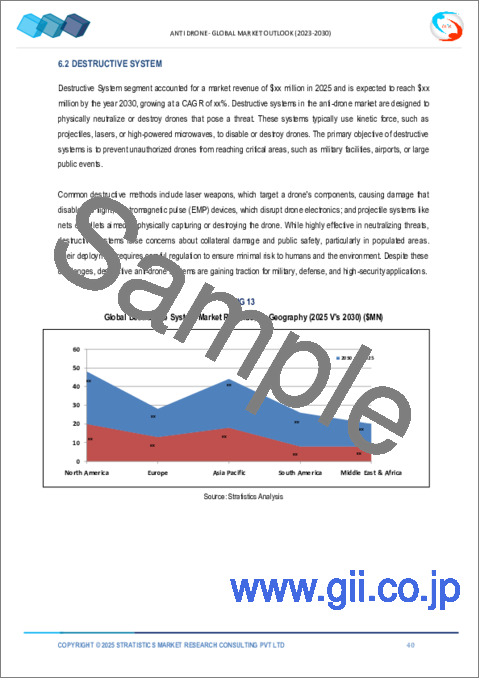
- Table 8 Global Anti Drone Market Outlook, By Destructive System (2022-2030) ($MN)
- Table 9 Global Anti Drone Market Outlook, By Missile Effector (2022-2030) ($MN)
- Table 10 Global Anti Drone Market Outlook, By Laser System (2022-2030) ($MN)
- Table 11 Global Anti Drone Market Outlook, By Electronic Countermeasure (2022-2030) ($MN)
- Table 12 Global Anti Drone Market Outlook, By Non-Destructive System (2022-2030) ($MN)
- Table 13 Global Anti Drone Market Outlook, By Technology (2022-2030) ($MN)
- Table 14 Global Anti Drone Market Outlook, By Disruption (2022-2030) ($MN)
- Table 15 Global Anti Drone Market Outlook, By Detection (2022-2030) ($MN)
- Table 16 Global Anti Drone Market Outlook, By Neutralization (2022-2030) ($MN)
- Table 17 Global Anti Drone Market Outlook, By Laser System (2022-2030) ($MN)
- Table 18 Global Anti Drone Market Outlook, By Kinetic System (2022-2030) ($MN)
- Table 19 Global Anti Drone Market Outlook, By Other Technologies (2022-2030) ($MN)
- Table 20 Global Anti Drone Market Outlook, By Application (2022-2030) ($MN)
- Table 21 Global Anti Drone Market Outlook, By Public Venues (2022-2030) ($MN)
- Table 22 Global Anti Drone Market Outlook, By Airports (2022-2030) ($MN)
- Table 23 Global Anti Drone Market Outlook, By Prisons (2022-2030) ($MN)
- Table 24 Global Anti Drone Market Outlook, By Critical Infrastructure Operators (2022-2030) ($MN)
- Table 25 Global Anti Drone Market Outlook, By Households and Homeland Security (2022-2030) ($MN)
- Table 26 Global Anti Drone Market Outlook, By Data Centers and Corporations (2022-2030) ($MN)
- Table 27 Global Anti Drone Market Outlook, By Stadiums and Arenas (2022-2030) ($MN)
- Table 28 Global Anti Drone Market Outlook, By Other Applications (2022-2030) ($MN)
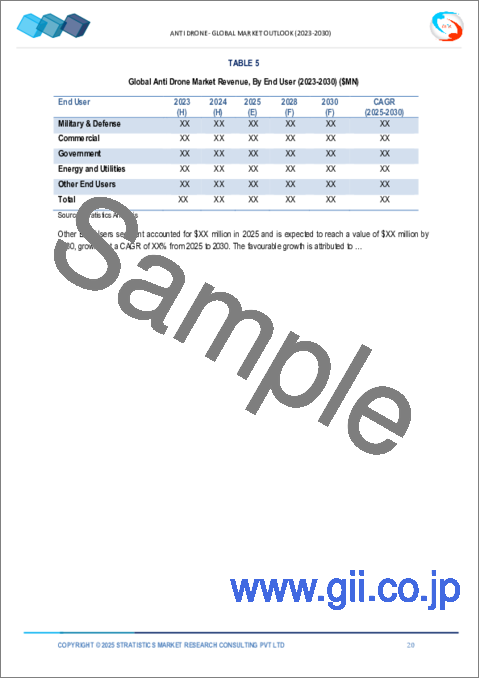
- Table 29 Global Anti Drone Market Outlook, By End User (2022-2030) ($MN)
- Table 30 Global Anti Drone Market Outlook, By Military & Defense (2022-2030) ($MN)
- Table 31 Global Anti Drone Market Outlook, By Commercial (2022-2030) ($MN)
- Table 32 Global Anti Drone Market Outlook, By Government (2022-2030) ($MN)
- Table 33 Global Anti Drone Market Outlook, By Energy and Utilities (2022-2030) ($MN)
- Table 34 Global Anti Drone Market Outlook, By Other End Users (2022-2030) ($MN)
Note: Tables for North America, Europe, APAC, South America, and Middle East & Africa Regions are also represented in the same manner as above.
According to Stratistics MRC, the Global Anti Drone Market is accounted for $3.1 billion in 2024 and is expected to reach $16.1 billion by 2030 growing at a CAGR of 31.6% during the forecast period. Anti-drone is systems or measures designed to detect, track, mitigate, or neutralize unauthorized or hostile drones. These systems are utilized to protect sensitive areas such as airports, government buildings, military installations, public events, and critical infrastructure from potential threats posed by drones, including unauthorized surveillance, smuggling, or malicious attacks. Anti-drone technologies can include radar systems, radio frequency (RF) detectors, jamming devices, net guns, lasers, and even trained birds of prey. The goal of anti-drone measures is to ensure safety, security, and privacy in areas where drones could present risks or disruptions.
According to the Association of the United States Army, terrorist groups have utilized or attempted to employ airborne drones for various purposes, including intelligence gathering, explosive delivery, and chemical weapon delivery. The FAA (Federal Aviation Administration) permitted the commercial use of drones beyond the pilot's line of sight in 2020.
Market Dynamics:
Driver:
Increasing use of drones
The market is witnessing a surge in the utilization of drones themselves. Employing drones for countering other drones presents a paradoxical yet effective approach. These anti-drone drones are equipped with advanced technologies such as AI, machine learning, and computer vision to detect, track, and neutralize unauthorized drones. This trend underscores the evolving nature of counter-drone strategies, where the use of technology to combat technology is becoming increasingly prevalent.
Restraint:
Complexity of regulations
Navigating the market is fraught with complexity due to stringent regulations. With evolving technological capabilities, authorities continuously revise policies, adding layers of complexity for both manufacturers and users. Compliance requirements, such as registration, licensing, and restricted airspace designations, vary across regions, posing significant challenges for global operations. Consequently, stakeholders must remain vigilant and agile to ensure both legal compliance and effective countermeasure deployment in this intricate regulatory environment.
Opportunity:
Technological advancements
Innovations include AI-driven detection systems capable of identifying drone signatures amidst cluttered environments. Countermeasure solutions have evolved with directed energy weapons and electronic warfare techniques, offering precise and non-lethal means of neutralization. Integration of machine learning algorithms enhances response capabilities, enabling real-time decision-making for effective mitigation strategies. Additionally, advancements in drone jamming and spoofing technologies provide enhanced protection against malicious drone incursions.
Threat:
Limited public awareness
Despite the growing threats posed by rogue drones, many individuals and organizations remain unaware of available countermeasures. This lack of awareness hampers the adoption of anti-drone technologies, impeding market growth. Addressing this challenge requires concerted efforts in education and outreach, highlighting the importance of proactive drone defense measures in safeguarding airspace integrity and privacy. Increased public awareness can drive demand and spur innovation in the sector.
Covid-19 Impact:
The COVID-19 pandemic significantly impacted the Anti-Drone market, initially causing disruptions in supply chains and manufacturing processes due to lockdown measures and workforce shortages. However, the crisis also led to increased awareness of security vulnerabilities, driving demand for Anti-Drone solutions to protect critical infrastructure, events, and airspace. The market witnessed a surge in remote monitoring and autonomous systems adoption to enforce social distancing measures.
The neutralization segment is expected to be the largest during the forecast period
The neutralization is expected to be the largest during the forecast period. Neutralization technologies are pivotal in the anti-drone market, offering effective countermeasures against unauthorized drone activities. These solutions encompass various approaches, including signal jamming, laser systems, and physical interception methods. Signal jamming disrupts drone communication and control, rendering them inert or guiding them to a safe landing. Laser systems disable drones by targeting critical components.
The prisons segment is expected to have the highest CAGR during the forecast period
The prisons segment is expected to have the highest CAGR during the forecast period. With the increasing threat of drones being used for illicit activities such as smuggling contraband or conducting surveillance, prisons are investing in countermeasures to protect their facilities. This includes the deployment of drone detection systems, signal jammers, and even trained birds of prey to intercept drones. Such measures aim to bolster security and prevent unauthorized drone incursions into prison airspace, ensuring the safety and integrity of correctional facilities.
Region with largest share:
North America is projected to hold the largest market share during the forecast period driven by increasing security concerns and advancements in drone technology. With rising incidents of unauthorized drone intrusions in sensitive airspace, demand for counter-drone systems has surged. Key players are innovating with technologies like jamming, interception, and detection to mitigate drone threats effectively. Government regulations and investments in defense and critical infrastructure sectors further bolster market expansion, making the region a significant hub for anti-drone solutions.
Region with highest CAGR:
Asia Pacific is projected to hold the highest CAGR over the forecast period. The rapid advancement of technology has led to the development of sophisticated anti-drone systems capable of detecting, tracking, and neutralizing rogue drones. These systems employ a variety of technologies such as radar, radio frequency (RF) sensors, electro-optical/infrared (EO/IR) sensors, jamming devices, and drones equipped with nets or other capture mechanisms. Governments across the region are implementing regulations to address the risks associated with drones.
Key players in the market
Some of the key players in Anti Drone market include Raytheon Technologies Corporation, Thales Group, Zen Technologies Limited, SAAB AB, Rheinmetall AG, Elbit Systems Ltd, Lockheed Martin Corporation, Airbus SE, BAE Systems plc, Fortem Technologies, Boeing Company, DroneShield Limited, Blighter Surveillance Systems, Leonardo S.p.A.
Key Developments:
In August 2023, DroneShield Ltd introduced its Satellite Denial Systems designed for specific target areas. Various Global Navigation Satellite Systems (GNSS) are in use worldwide, including the well-known US GPS, along with the Russian GLONASS, the Chinese BeiDou, and the European Galileo system.
In June 2023, Leonardo S.p.A. launched two novel turrets, LIONFISH 30 and HITFIST 30 UL, catering to naval and land defense domains. These cutting-edge remote-controlled turrets incorporate the ITAR-free 30mm X-GUN, an in-house developed electric weapon system infused with patented technologies.
Types Covered:
- Ground Based
- UAV Based
- Handheld
- Other Types
Mitigation Types Covered:
- Destructive System
- Non-Destructive System
Technologies Covered:
- Disruption
- Detection
- Neutralization
- Laser System
- Kinetic System
- Other Technologies
Applications Covered:
- Public Venues
- Airports
- Prisons
- Critical Infrastructure Operators
- Households and Homeland Security
- Data Centers and Corporations
- Stadiums and Arenas
- Other Applications
End Users Covered:
- Military & Defense
- Commercial
- Government
- Energy and Utilities
- Other End Users
Regions Covered:
- North America
- US
- Canada
- Mexico
- Europe
- Germany
- UK
- Italy
- France
- Spain
- Rest of Europe
- Asia Pacific
- Japan
- China
- India
- Australia
- New Zealand
- South Korea
- Rest of Asia Pacific
- South America
- Argentina
- Brazil
- Chile
- Rest of South America
- Middle East & Africa
- Saudi Arabia
- UAE
- Qatar
- South Africa
- Rest of Middle East & Africa
What our report offers:
- Market share assessments for the regional and country-level segments
- Strategic recommendations for the new entrants
- Covers Market data for the years 2022, 2023, 2024, 2026, and 2030
- Market Trends (Drivers, Constraints, Opportunities, Threats, Challenges, Investment Opportunities, and recommendations)
- Strategic recommendations in key business segments based on the market estimations
- Competitive landscaping mapping the key common trends
- Company profiling with detailed strategies, financials, and recent developments
- Supply chain trends mapping the latest technological advancements
Free Customization Offerings:
All the customers of this report will be entitled to receive one of the following free customization options:
- Company Profiling
- Comprehensive profiling of additional market players (up to 3)
- SWOT Analysis of key players (up to 3)
- Regional Segmentation
- Market estimations, Forecasts and CAGR of any prominent country as per the client's interest (Note: Depends on feasibility check)
- Competitive Benchmarking
- Benchmarking of key players based on product portfolio, geographical presence, and strategic alliances
Table of Contents
1 Executive Summary
2 Preface
- 2.1 Abstract
- 2.2 Stake Holders
- 2.3 Research Scope
- 2.4 Research Methodology
- 2.4.1 Data Mining
- 2.4.2 Data Analysis
- 2.4.3 Data Validation
- 2.4.4 Research Approach
- 2.5 Research Sources
- 2.5.1 Primary Research Sources
- 2.5.2 Secondary Research Sources
- 2.5.3 Assumptions
3 Market Trend Analysis
- 3.1 Introduction
- 3.2 Drivers
- 3.3 Restraints
- 3.4 Opportunities
- 3.5 Threats
- 3.6 Technology Analysis
- 3.7 Application Analysis
- 3.8 End User Analysis
- 3.9 Emerging Markets
- 3.10 Impact of Covid-19
4 Porters Five Force Analysis
- 4.1 Bargaining power of suppliers
- 4.2 Bargaining power of buyers
- 4.3 Threat of substitutes
- 4.4 Threat of new entrants
- 4.5 Competitive rivalry
5 Global Anti Drone Market, By Type
- 5.1 Introduction
- 5.2 Ground Based
- 5.3 UAV Based
- 5.4 Handheld
- 5.5 Other Types
6 Global Anti Drone Market, By Mitigation Type
- 6.1 Introduction
- 6.2 Destructive System
- 6.2.1 Missile Effector
- 6.2.2 Laser System
- 6.2.3 Electronic Countermeasure
- 6.3 Non-Destructive System
7 Global Anti Drone Market, By Technology
- 7.1 Introduction
- 7.2 Disruption
- 7.3 Detection
- 7.4 Neutralization
- 7.5 Laser System
- 7.6 Kinetic System
- 7.7 Other Technologies
8 Global Anti Drone Market, By Application
- 8.1 Introduction
- 8.2 Public Venues
- 8.3 Airports
- 8.4 Prisons
- 8.5 Critical Infrastructure Operators
- 8.6 Households and Homeland Security
- 8.7 Data Centers and Corporations
- 8.8 Stadiums and Arenas
- 8.9 Other Applications
9 Global Anti Drone Market, By End User
- 9.1 Introduction
- 9.2 Military & Defense
- 9.3 Commercial
- 9.4 Government
- 9.5 Energy and Utilities
- 9.6 Other End Users
10 Global Anti Drone Market, By Geography
- 10.1 Introduction
- 10.2 North America
- 10.2.1 US
- 10.2.2 Canada
- 10.2.3 Mexico
- 10.3 Europe
- 10.3.1 Germany
- 10.3.2 UK
- 10.3.3 Italy
- 10.3.4 France
- 10.3.5 Spain
- 10.3.6 Rest of Europe
- 10.4 Asia Pacific
- 10.4.1 Japan
- 10.4.2 China
- 10.4.3 India
- 10.4.4 Australia
- 10.4.5 New Zealand
- 10.4.6 South Korea
- 10.4.7 Rest of Asia Pacific
- 10.5 South America
- 10.5.1 Argentina
- 10.5.2 Brazil
- 10.5.3 Chile
- 10.5.4 Rest of South America
- 10.6 Middle East & Africa
- 10.6.1 Saudi Arabia
- 10.6.2 UAE
- 10.6.3 Qatar
- 10.6.4 South Africa
- 10.6.5 Rest of Middle East & Africa
11 Key Developments
- 11.1 Agreements, Partnerships, Collaborations and Joint Ventures
- 11.2 Acquisitions & Mergers
- 11.3 New Product Launch
- 11.4 Expansions
- 11.5 Other Key Strategies
12 Company Profiling
- 12.1 Raytheon Technologies Corporation
- 12.2 Thales Group
- 12.3 Zen Technologies Limited
- 12.4 SAAB AB
- 12.5 Rheinmetall AG
- 12.6 Elbit Systems Ltd
- 12.7 Lockheed Martin Corporation
- 12.8 Airbus SE
- 12.9 BAE Systems plc
- 12.10 Fortem Technologies
- 12.11 Boeing Company
- 12.12 DroneShield Limited
- 12.13 Blighter Surveillance Systems
- 12.14 Leonardo S.p.A.