


インドのガソリンスタンド-市場シェア分析、産業動向と統計、成長予測(2025年~2030年)
India Petrol Station - Market Share Analysis, Industry Trends & Statistics, Growth Forecasts (2025 - 2030)


- 発行日
- ページ情報
- 英文 95 Pages
- 納期
- 2~3営業日
- 商品コード
- 1635475
- カスタマイズ可能 お客様のご希望に応じて、既存データの加工や未掲載情報(例:国別セグメント)の追加などの対応が可能です。詳細はお問い合わせください。
- 適宜更新あり 本レポートは最新情報反映のため適宜更新し、内容構成変更を行う場合があります。ご検討の際はお問い合わせください。
- 翻訳ツール提供対象 PDF対応AI翻訳ツールの無料貸し出しサービスのご利用が可能です
概要
インドのガソリンスタンド市場は予測期間中にCAGR 5%超を記録する見込み。
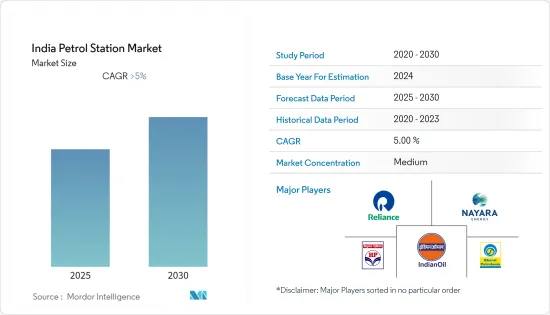
COVID-19は2020年の市場にマイナスの影響を与えました。現在、市場は大流行前の水準に達しています。
主要ハイライト
- 長期的には、石油製品需要の増加やインドにおける乗用車販売の増加といった要因が、予測期間中の市場の成長を後押しするとみられます。
- 一方、ガソリン・ディーゼル燃料のコスト上昇は、今後数年間のガソリンスタンド燃料市場の成長を抑制すると予想されます。
- 電気自動車(EV)の充電設備や圧縮天然ガスに加え、ガソリン、ディーゼル、フレックス燃料など複数の給油オプションを提供するようインドのガソリンスタンドを転換することは、将来的に大きな機会を提供すると予想されます。
インドのガソリンスタンド市場動向
民間所有セグメントが最も急成長する市場になる見込み
- 民間所有セグメントは、燃料需要の増加とインドにおける燃料小売の自由化により、予測期間中に大きな成長が見込まれます。
- 将来の可能性に注目し、様々な世界企業がインドの燃料小売セグメントへの参入に関心を寄せています。2022年5月1日現在、Reliance Industries Limitedは1,459ヵ所、Nayara Energy(旧Essar Oil)は6,604ヵ所、Royal Dutch Shellは324ヵ所、その他企業は34ヵ所のガソリンスタンドを展開しています。これは、インドのガソリンスタンド市場の成長と同じです。
- 2022年6月、インド政府はすべての小売店舗に対するユニバーサルサービス義務(USO)の実施を発表しました。この規則により、ガソリンスタンドはガソリンとディーゼルの販売を中止することができなくなりました。このルールは僻地のガソリンスタンドにも適用されます。政府は、このルールに従わない者は免許を取り消すと明言しています。
- また、石油天然ガス省によると、2021~2022年度(2022年4月9日現在)のインドのガソリン消費量は前年度比13%増の3,085万トン、ディーゼルは5%増の7,669万トンに達しました。インド政府はガソリンと航空燃料の販売規制を緩和し、British Petroleum、TotalEnergies、Trafiguraのような民間企業のインド進出を奨励しています。このため、予測期間中は非公開会社が市場を独占することになると考えられます。
- したがって、燃料需要の増加とインドのガソリンスタンドセクターにおける民間企業の関心の高まりにより、民間所有セグメントは予測期間中に大きく成長すると予想されます。
乗用車普及率の上昇が市場成長に寄与する可能性
- インドは世界有数の経済大国です。さらに、人口増加、都市化、工業化により、予測期間中も経済成長率が最も高い国であり続けると予想されます。
- 同国は近年目覚ましい経済成長を遂げており、生活水準と平均所得が上昇しています。自動車販売台数も近年着実に増加しています。
- インドの年間自動車総販売台数は、2008年の198万台から2021年には378万台に増加し、そのうち乗用車だけで306万台を占めています。さらに、予測期間中、自動車販売台数は伸びると予想され、同国における燃料とガソリンスタンドの需要が増加する可能性があります。
- インドの中間層の台頭は自動車販売に不可欠です。さらに、2030年までに推定5億人が中・高所得層に移行すると見られています。これは、自動車販売の増加とともに進むと予想されます。
- 従って、これら全ての要因がインドにおける自動車販売の増加を引き起こし、予測期間中に小売ガソリンスタンドの需要を促進するものと考えられます。
インドのガソリンスタンド産業概要
インドのガソリンスタンド市場は適度に統合されています。主要企業(順不同)には、Indian Oil Corporation Ltd、Bharat Petroleum Corp.Ltd.、Hindustan Petroleum Corporation Limited、Nayara Energy Limited、Reliance Industries Limitedなどがあります。
その他の特典
- エクセル形式の市場予測(ME)シート
- 3ヶ月間のアナリストサポート
目次
第1章 イントロダクション
- 調査範囲
- 市場の定義
- 調査の前提
第2章 エグゼクティブサマリー
第3章 調査手法
第4章 市場概要
- イントロダクション
- 2027年までの市場規模と需要予測(単位:10億米ドル)
- インドの企業別小売ガソリンスタンド数(2013~2021年)
- インドの州別小売ガソリンスタンド数(2021年)
- インドのガソリン・ディーゼル消費動向(2021年)
- 最近の動向と開発
- 政府の規制と施策
- 市場力学
- 促進要因
- 抑制要因
- サプライチェーン分析
- PESTLE分析
第5章 市場セグメンテーション
- 所有者
- 公的セクター
- 民間企業
- エンドユーザー別
- 公共部門
- 民間セクター
第6章 競合情勢
- M&A、合弁事業、提携、協定
- 主要企業の戦略
- 企業プロファイル
- Indian Oil Corporation Ltd
- Bharat Petroleum Corp. Ltd
- Hindustan Petroleum Corporation Limited
- Nayara Energy Limited
- Reliance Industries Limited
- Royal Dutch Shell PLC
- TotalEnergies SA
第7章 市場機会と今後の動向
目次
The India Petrol Station Market is expected to register a CAGR of greater than 5% during the forecast period.
COVID-19 negatively impacted the market in 2020. Presently the market has now reached pre-pandemic levels.
Key Highlights
- Over the long term, factors such as increasing demand for petroleum products and the rising sale of passenger vehicles in India are expected to help the market grow during the forecast period.
- On the other note, the increasing cost of petrol & diesel fuels is anticipated to restrain the growth of the fuel station fuel market in the coming years.
- Nevertheless, converting the fuel stations in India to provide multiple fueling options such as petrol, diesel, and flex fuels, besides electric vehicle (EV) charging facilities, compressed natural gas is expected to offer vast opportunities in the future.
India Petrol Station Market Trends
The Private Owned Segment is Expected to be the Fastest-Growing Market
- The private-owned segment is expected to witness significant growth during the forecast period due to rising fuel demand and the liberalization of fuel retailing in India.
- Looking at the future potential, various global players are interested in entering the Indian fuel retail segment. As of 1st May 2022, Reliance Industries Limited has 1,459 fuel stations, Nayara Energy (formerly Essar Oil) has 6,604, Royal Dutch Shell has 324 outlets, and other companies have 34 outlets. This, in turn, replicates the growth in the Indian fuel station market.
- In June 2022, The government of India announced the implementation of Universal Service Obligation (USO) for all retail outlets. As per the rule, petrol pumps cannot stop selling petrol and diesel. This rule is also applicable to petrol pumps in remote areas. The government has made it clear that whoever does not follow these rules will get their license canceled.
- Moreover, according to the Ministry of Petroleum and Natural Gas, during the FY2021-2022 (as of 9th April 2022), Indian gasoline consumption rose to 30.85 million metric tonnes (MMT), showing a growth of 13% compared to the previous year, and the diesel has reached 76.69 MMT with a 5% rise from FY2020-21. The Government of India is relaxing restrictions on the sale of gasoline and aviation fuel and encouraging private players like British Petroleum, TotalEnergies, and Trafigura in India. This is likely to make the companies in the private-owned segment dominate the market during the forecast period.
- Hence, with the increase in demand for fuel and the growing interest of the private players in the Indian fuel station sector, the private-owned segment is expected to grow significantly during the forecast period.
Rising Passenger Vehicles Penetration May Help the Market Grow
- India is one of the largest economies in the world. Further, the country is expected to remain the fastest-growing economy during the forecast period due to the rising population, urbanization, and industrialization.
- The country has seen remarkable economic growth in recent years, with rising living standards and average income. A steady rise in vehicle sales has also been witnessed in recent years.
- India has seen a total annual vehicle sales rise from 1.98 million in 2008 to 3.78 million in 2021, of which the passenger vehicles alone accounted for 3.06 million. Further, vehicle sales are expected to grow during the forecast period, which may increase the demand for fuel and fuel stations in the country.
- The rise of the Indian middle class is essential in vehicle sales. Moreover, an estimated 500 million people will likely move into the middle-and high-income brackets by 2030. This is expected to go together with the rise in vehicle sales.
- Hence, all these factors are expected to cause a rise in vehicle sales in India, likely to propel the demand for retail fuel stations during the forecast period.
India Petrol Station Industry Overview
The Indian fuel station market is moderately consolidated. Some of the key players (in no particular order) include Indian Oil Corporation Ltd, Bharat Petroleum Corp. Ltd, Hindustan Petroleum Corporation Limited, Nayara Energy Limited, and Reliance Industries Limited.
Additional Benefits:
- The market estimate (ME) sheet in Excel format
- 3 months of analyst support
TABLE OF CONTENTS
1 INTRODUCTION
- 1.1 Scope of the Study
- 1.2 Market Definition
- 1.3 Study Assumptions
2 EXECUTIVE SUMMARY
3 RESEARCH METHODOLOGY
4 MARKET OVERVIEW
- 4.1 Introduction
- 4.2 Market Size and Demand Forecast in USD billion, till 2027
- 4.3 Company-Wise Retail Fuel Stations in India, 2013-2021
- 4.4 State-Wise Retail Fuel Stations in India, 2021
- 4.5 India Gasoline and Diesel Consumption Trends, till 2021
- 4.6 Recent Trends and Developments
- 4.7 Government Policies and Regulations
- 4.8 Market Dynamics
- 4.8.1 Drivers
- 4.8.2 Restraints
- 4.9 Supply Chain Analysis
- 4.10 PESTLE Analysis
5 MARKET SEGMENTATION
- 5.1 Ownership
- 5.1.1 Public Sector Undertakings
- 5.1.2 Private Owned
- 5.2 By End-User
- 5.2.1 Public-Sector
- 5.2.2 Private-Sector
6 COMPETITIVE LANDSCAPE
- 6.1 Mergers and Acquisitions, Joint Ventures, Collaborations, and Agreements
- 6.2 Strategies Adopted by Leading Players
- 6.3 Company Profiles
- 6.3.1 Indian Oil Corporation Ltd
- 6.3.2 Bharat Petroleum Corp. Ltd
- 6.3.3 Hindustan Petroleum Corporation Limited
- 6.3.4 Nayara Energy Limited
- 6.3.5 Reliance Industries Limited
- 6.3.6 Royal Dutch Shell PLC
- 6.3.7 TotalEnergies SA
7 MARKET OPPORTUNITIES AND FUTURE TRENDS
- 発行日
- 発行
- Mordor Intelligence
- ページ情報
- 英文 95 Pages
- 納期
- 2~3営業日


