

|
市場調査レポート
商品コード
1792397
アクチュエータの市場レポート:製品別、タイプ別、最終用途産業別、地域別、2025~2033年Actuators Market Report by Product, Type, End Use Industry, and Region 2025-2033 |
||||||
|
|
|||||||
カスタマイズ可能
|
|||||||
| アクチュエータの市場レポート:製品別、タイプ別、最終用途産業別、地域別、2025~2033年 |
|
出版日: 2025年08月01日
発行: IMARC
ページ情報: 英文 144 Pages
納期: 2~3営業日
|

全表示
- 概要
- 図表
- 目次
世界のアクチュエータの市場規模は2024年に472億米ドルに達しました。IMARC Groupは、同市場が2033年までに808億米ドルに達し、2025~2033年にかけて6.14%の成長率(CAGR)を示すと予測しています。産業オートメーションの拡大、インダストリー4.0の登場、急速な工業化、進行中のインフラ開発、厳しい規制の実施、エネルギー効率と持続可能性への注目の高まりなどが、市場を推進する主な要因の一部です。
アクチュエータは、エネルギーを運動に変換する機械装置を指します。このエネルギーは電気、油圧、空気圧から供給されることが多く、アクチュエータは多くの場合、産業用システムや機械システム内で特定の動作を行うことができます。このような動作は、単純な直線運動から複雑な多軸運動まで様々であり、それによって様々な産業作業を可能にします。アクチュエータは、製造業、自動車、航空宇宙、ロボット工学などの多様な分野に不可欠であり、プロセスの自動化と合理化において重要な役割を果たしています。アクチュエータは、オートメーションシステムの万能コンポーネントとして、制御信号を物理的動作に変換し、効率と精度の向上に貢献します。
自動車産業、製造業、航空宇宙産業における産業オートメーションの台頭は、アクチュエータの需要を促進しています。また、インダストリー4.0やモノのインターネット(IoT)の登場により、より統合されたスマートファクトリーが登場し、複雑で正確なオペレーションを実現するためにアクチュエータが採用されています。さらに、生産性と効率性の向上に対するニーズの高まり、エネルギー効率と持続可能な実践に向けた新たな動向が、市場成長の好材料となっています。さらに、新興経済諸国におけるインフラ開発の拡大が、建設機械や水処理プラントなどの用途におけるアクチュエータの需要を促進しています。さらに、研究開発(R&D)活動への投資の急増や、問題を自己診断し、メンテナンスのために報告することができるスマートアクチュエータの開発などの継続的な技術進歩が、運用ダウンタイムを大幅に削減し、システムの寿命を向上させ、市場拡大の一助となっています。
アクチュエータ市場の動向と促進要因:
産業オートメーションの拡大
生産性の向上、業務効率の改善、精度と正確さの必要性などを背景とした産業オートメーションの急増が、アクチュエータの需要を大幅に押し上げています。アクチュエータは、応答時間の短縮、正確な位置決め、高負荷への対応などの利点を提供し、様々な産業で重要な役割を果たしています。さらに、ヒューマンエラーを最小限に抑え、エネルギー消費を最適化し、予知保全を容易にすることでコストを削減する製品の採用が広がっていることも、市場を前進させています。さらに、人工知能(AI)や機械学習(ML)の組み込みなど、自動化技術における継続的な技術革新と進歩が、高度なアクチュエータの需要を後押ししています。これと同時に、協働ロボット(cobot)の採用が増加し、産業用モノのインターネット(IIoT)の実装が、インテリジェントオートメーションの実現におけるアクチュエータの重要性をさらに高めています。
インダストリー4.0とIoTの台頭
インダストリー4.0とIoTの台頭は、産業オペレーションにパラダイムシフトをもたらしました。IoTに対応したアクチュエータにより、産業界はより高度な精度、制御、自動化を実現することができます。センサーを搭載し、IoTネットワークに接続することで、リアルタイムのモニタリングやデータ収集を可能にするスマートアクチュエータの需要が高まっており、市場にとって有益な成長機会となっています。スマートアクチュエータは、温度、圧力、性能指標などのパラメータを継続的に監視することで、潜在的な問題や最適な状態からの逸脱を特定し、予防的なメンテナンスを可能にし、コストのかかるダウンタイムを最小限に抑えることができます。さらに、IoT対応のアクチュエータは、接続されたエコシステム内でのシームレスな統合と相互運用性を促進し、多くの産業分野での採用を促進しています。他のデバイス、機械、システムとの通信や連携が可能なため、同期化された協調運転が可能になります。
エネルギー効率と持続可能性への需要の高まり
世界的にエネルギー効率と持続可能性が重視されるようになり、電動アクチュエータ技術が大きく進歩しました。電動アクチュエータは、その環境に優しい特性と優れた性能特性により人気を博しています。油圧や空圧のアクチュエータに比べ、電動アクチュエータはエネルギー効率が高く、環境への影響が少ないことで知られています。これは、より環境に優しい産業活動の世界の推進と、より厳しい環境規制の遵守と一致しています。電動アクチュエータのエネルギー消費量の削減は、産業界のコスト削減にもつながり、環境と経済の両面から魅力的な選択肢となります。世界中の政府や産業界が環境への影響を軽減し、持続可能な慣行を取り入れる努力を強めているため、電動アクチュエータのようなエネルギー効率の高いソリューションに対する需要は、予測期間中に拡大すると予想されます。
目次
第1章 序文
第2章 調査範囲と調査手法
- 調査の目的
- ステークホルダー
- データソース
- 一次情報
- 二次情報
- 市場推定
- ボトムアップアプローチ
- トップダウンアプローチ
- 調査手法
第3章 エグゼクティブサマリー
第4章 イントロダクション
- 概要
- 主要業界動向
第5章 世界のアクチュエータ市場
- 市場概要
- 市場実績
- COVID-19の影響
- 市場内訳:製品別
- 市場内訳:タイプ別
- 市場内訳:最終用途産業別
- 市場内訳:地域別
- 市場予測
第6章 市場内訳:製品別
- リニアアクチュエータ
- 主な種類
- ロッドタイプ
- スクリュータイプ
- ベルトタイプ
- 主な種類
- ロータリーアクチュエータ
- 主な種類
- モーター
- ブラダー・ベーン
- ピストンタイプ
- 主な種類
第7章 市場内訳:タイプ別
- 電動式
- 空圧式
- 油圧式
- 機械式
- その他
第8章 市場内訳:最終用途産業別
- 石油・ガス
- 発電
- 化学
- 飲食品
- 金属・鉱業
- 自動車
- 航空宇宙・防衛
- その他
第9章 市場内訳:地域別
- 北米
- 欧州
- アジア太平洋地域
- 中東・アフリカ
- ラテンアメリカ
第10章 SWOT分析
- 概要
- 強み
- 弱み
- 機会
- 脅威
第11章 バリューチェーン分析
第12章 ポーターのファイブフォース分析
- 概要
- 買い手の交渉力
- 供給企業の交渉力
- 競合の程度
- 新規参入業者の脅威
- 代替品の脅威
第13章 価格分析
第14章 競合情勢
- 市場構造
- 主要企業
- 主要企業のプロファイル
- Rockwell Automation
- Moog Inc
- Emerson Electric
- ABB
- SMC Corporation
- IMI PLC
- Flowserve
- Altra Industrial Motion
- Cedrat Technologies
- DVG Automation
- Festo
- MISUMI Group Inc
- Harmonic Drive LLC
- Kinitics Automation
- Venture Mfg. Co
List of Figures
- Figure 1: Global: Actuators Market: Major Drivers and Challenges
- Figure 2: Global: Actuators Market: Sales Value (in Billion USD), 2019-2024
- Figure 3: Global: Actuators Market: Breakup by Product (in %), 2024
- Figure 4: Global: Actuators Market: Breakup by Type (in %), 2024
- Figure 5: Global: Actuators Market: Breakup by End Use Industry (in %), 2024
- Figure 6: Global: Actuators Market: Breakup by Region (in %), 2024
- Figure 7: Global: Actuators Market Forecast: Sales Value (in Billion USD), 2025-2033
- Figure 8: Global: Actuators Industry: SWOT Analysis
- Figure 9: Global: Actuators Industry: Value Chain Analysis
- Figure 10: Global: Actuators Industry: Porter's Five Forces Analysis
- Figure 11: Global: Actuators (Linear Actuators) Market: Sales Value (in Billion USD), 2019 & 2024
- Figure 12: Global: Actuators (Linear Actuators) Market Forecast: Sales Value (in Billion USD), 2025-2033
- Figure 13: Global: Actuators (Rotary Actuators) Market: Sales Value (in Billion USD), 2019 & 2024
- Figure 14: Global: Actuators (Rotary Actuators) Market Forecast: Sales Value (in Billion USD), 2025-2033
- Figure 15: Global: Actuators (Electric) Market: Sales Value (in Billion USD), 2019 & 2024
- Figure 16: Global: Actuators (Electric) Market Forecast: Sales Value (in Billion USD), 2025-2033
- Figure 17: Global: Actuators (Pneumatic) Market: Sales Value (in Billion USD), 2019 & 2024
- Figure 18: Global: Actuators (Pneumatic) Market Forecast: Sales Value (in Billion USD), 2025-2033
- Figure 19: Global: Actuators (Hydraulic) Market: Sales Value (in Billion USD), 2019 & 2024
- Figure 20: Global: Actuators (Hydraulic) Market Forecast: Sales Value (in Billion USD), 2025-2033
- Figure 21: Global: Actuators (Mechanical) Market: Sales Value (in Billion USD), 2019 & 2024
- Figure 22: Global: Actuators (Mechanical) Market Forecast: Sales Value (in Billion USD), 2025-2033
- Figure 23: Global: Actuators (Other Types) Market: Sales Value (in Billion USD), 2019 & 2024
- Figure 24: Global: Actuators (Other Types) Market Forecast: Sales Value (in Billion USD), 2025-2033
- Figure 25: Global: Actuators (Oil and Gas) Market: Sales Value (in Billion USD), 2019 & 2024
- Figure 26: Global: Actuators (Oil and Gas) Market Forecast: Sales Value (in Billion USD), 2025-2033
- Figure 27: Global: Actuators (Power Generation) Market: Sales Value (in Billion USD), 2019 & 2024
- Figure 28: Global: Actuators (Power Generation) Market Forecast: Sales Value (in Billion USD), 2025-2033
- Figure 29: Global: Actuators (Chemicals) Market: Sales Value (in Billion USD), 2019 & 2024
- Figure 30: Global: Actuators (Chemicals) Market Forecast: Sales Value (in Billion USD), 2025-2033
- Figure 31: Global: Actuators (Food and Beverages) Market: Sales Value (in Billion USD), 2019 & 2024
- Figure 32: Global: Actuators (Food and Beverages) Market Forecast: Sales Value (in Billion USD), 2025-2033
- Figure 33: Global: Actuators (Metals and Mining) Market: Sales Value (in Billion USD), 2019 & 2024
- Figure 34: Global: Actuators (Metals and Mining) Market Forecast: Sales Value (in Billion USD), 2025-2033
- Figure 35: Global: Actuators (Automotive) Market: Sales Value (in Billion USD), 2019 & 2024
- Figure 36: Global: Actuators (Automotive) Market Forecast: Sales Value (in Billion USD), 2025-2033
- Figure 37: Global: Actuators (Aerospace and Defense) Market: Sales Value (in Billion USD), 2019 & 2024
- Figure 38: Global: Actuators (Aerospace and Defense) Market Forecast: Sales Value (in Billion USD), 2025-2033
- Figure 39: Global: Actuators (Other End Use Industries) Market: Sales Value (in Billion USD), 2019 & 2024
- Figure 40: Global: Actuators (Other End Use Industries) Market Forecast: Sales Value (in Billion USD), 2025-2033
- Figure 41: North America: Actuators Market: Sales Value (in Billion USD), 2019 & 2024
- Figure 42: North America: Actuators Market Forecast: Sales Value (in Billion USD), 2025-2033
- Figure 43: Europe: Actuators Market: Sales Value (in Billion USD), 2019 & 2024
- Figure 44: Europe: Actuators Market Forecast: Sales Value (in Billion USD), 2025-2033
- Figure 45: Asia Pacific: Actuators Market: Sales Value (in Billion USD), 2019 & 2024
- Figure 46: Asia Pacific: Actuators Market Forecast: Sales Value (in Billion USD), 2025-2033
- Figure 47: Middle East and Africa: Actuators Market: Sales Value (in Billion USD), 2019 & 2024
- Figure 48: Middle East and Africa: Actuators Market Forecast: Sales Value (in Billion USD), 2025-2033
- Figure 49: Latin America: Actuators Market: Sales Value (in Billion USD), 2019 & 2024
- Figure 50: Latin America: Actuators Market Forecast: Sales Value (in Billion USD), 2025-2033
List of Tables
- Table 1: Global: Actuators Market: Key Industry Highlights, 2024 and 2033
- Table 2: Global: Actuators Market Forecast: Breakup by Product (in Billion USD), 2025-2033
- Table 3: Global: Actuators Market Forecast: Breakup by Type (in Billion USD), 2025-2033
- Table 4: Global: Actuators Market Forecast: Breakup by End Use Industry (in Billion USD), 2025-2033
- Table 5: Global: Actuators Market Forecast: Breakup by Region (in Billion USD), 2025-2033
- Table 6: Global: Actuators Market Structure
- Table 7: Global: Actuators Market: Key Players
The global actuators market size reached USD 47.2 Billion in 2024. Looking forward, IMARC Group expects the market to reach USD 80.8 Billion by 2033, exhibiting a growth rate (CAGR) of 6.14% during 2025-2033. Expanding industrial automation, the advent of Industry 4.0, rapid industrialization, ongoing infrastructural development, the implementation of stringent regulations, and the rising focus on energy efficiency and sustainability are some of the major factors propelling the market.
Actuators refer to mechanical devices that convert energy into motion. This energy, often sourced from electrical, hydraulic, or pneumatic power, enables the actuator to perform a specific action, often within an industrial or mechanical system. These actions may vary from simple linear motion to complex multi-axis movements, thereby enabling various industrial operations. Actuators are integral to diverse sectors, such as manufacturing, automotive, aerospace, and robotics, serving crucial roles in automating and streamlining processes. As versatile components of automation systems, actuators help enhance efficiency and precision, translating control signals into physical action.
The rising industrial automation across the automotive, manufacturing, and aerospace sectors is fueling the demand for actuators. Besides this, the advent of Industry 4.0 and the Internet of Things (IoT) has led to more integrated and smart factories, wherein actuators are employed for achieving complex and precise operations. Moreover, the growing need for improved productivity and efficiency and the emerging trend towards energy efficiency and sustainable practices is creating a favorable outlook for market growth. Additionally, the expanding infrastructural development in emerging economies is driving the demand for actuators in applications such as construction machinery and water treatment plants. Furthermore, surging investments in research and development (R&D) activities and ongoing technological advancements, such as the development of smart actuators that can self-diagnose issues and report them for maintenance, significantly reducing operational downtime and enhancing system longevity, are aiding in market expansion.
Actuators Market Trends/Drivers:
Expanding industrial automation
The surge in industrial automation driven by increased productivity, improved operational efficiency, and the need for precision and accuracy has significantly boosted the demand for actuators. Actuators play a vital role in various industries, offering advantages such as faster response times, precise positioning, and the ability to handle heavy loads. Furthermore, the widespread product adoption to reduce costs by minimizing human error, optimizing energy consumption, and facilitating predictive maintenance is propelling the market forward. Moreover, ongoing innovation and advancements in automation technologies, including the incorporation of artificial intelligence (AI) and machine learning (ML), are impelling the demand for advanced actuators. Concurrent with this, the increasing adoption of collaborative robots (cobots) and the implementation of the Industrial Internet of Things (IIoT) are further enhancing the significance of actuators in enabling intelligent automation.
The advent of Industry 4.0 and IoT
The emergence of Industry 4.0 and IoT has brought about a paradigm shift in industrial operations. With IoT-enabled actuators, industries can achieve enhanced precision, control, and automation. The rising demand for smart actuators, equipped with sensors and connected to IoT networks, enabling real-time monitoring and data collection, is presenting remunerative growth opportunities for the market. By continuously monitoring parameters such as temperature, pressure, and performance metrics, smart actuators can identify potential issues or deviations from optimal conditions, allowing for proactive maintenance and minimizing costly downtime. Moreover, IoT-enabled actuators facilitate seamless integration and interoperability within a connected ecosystem, fueling their adoption across numerous industrial verticals. They can communicate and collaborate with other devices, machines, and systems, enabling synchronized and coordinated operations.
Rising demand for energy efficiency and sustainability
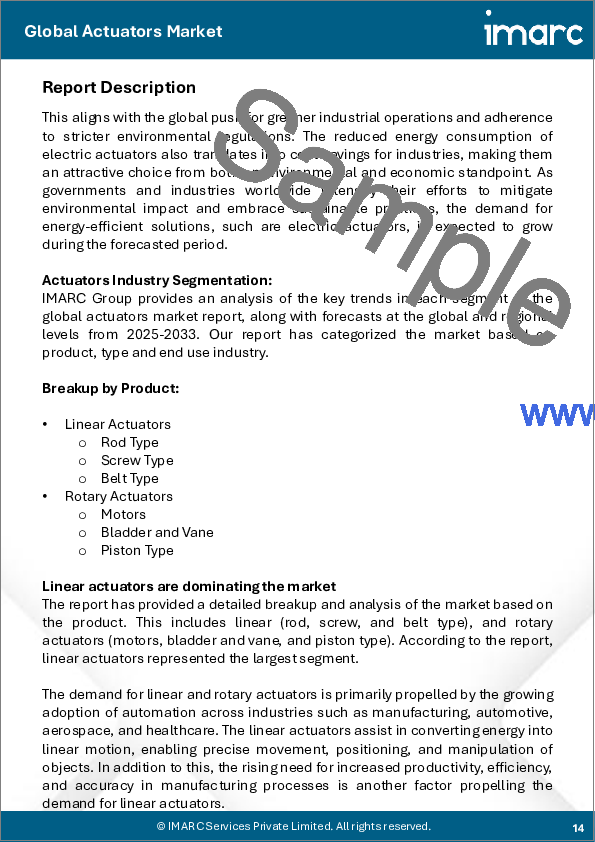
The global emphasis on energy efficiency and sustainability has driven significant advancements in electric actuator technology. Electric actuators have gained traction due to their eco-friendly characteristics and superior performance attributes. Compared to hydraulic and pneumatic actuators, electric actuators are known for their higher energy efficiency and lower environmental impact. This aligns with the global push for greener industrial operations and adherence to stricter environmental regulations. The reduced energy consumption of electric actuators also translates into cost savings for industries, making them an attractive choice from both an environmental and economic standpoint. As governments and industries worldwide intensify their efforts to mitigate environmental impact and embrace sustainable practices, the demand for energy-efficient solutions, such are electric actuators, is expected to grow during the forecasted period.
Actuators Industry Segmentation:
Breakup by Product:
- Linear Actuators
- Rod Type
- Screw Type
- Belt Type
- Rotary Actuators
- Motors
- Bladder and Vane
- Piston Type
Linear actuators are dominating the market
The demand for linear and rotary actuators is primarily propelled by the growing adoption of automation across industries such as manufacturing, automotive, aerospace, and healthcare. The linear actuators assist in converting energy into linear motion, enabling precise movement, positioning, and manipulation of objects. In addition to this, the rising need for increased productivity, efficiency, and accuracy in manufacturing processes is another factor propelling the demand for linear actuators. They are essential in assembly lines, material handling systems, robotics, and other applications requiring precise linear motion. Apart from this, rotary actuators are used in applications that require rotational or angular motion, such as valve control, robotic arms, and positioning systems. As a result, the growing need for precise and controlled rotational movement for tasks such as steering, flight control, and automated production lines is impelling the demand for rotary actuators.
Breakup by Type:
- Electric
- Pneumatic
- Hydraulic
- Mechanical
- Others
Electric holds a larger share in market
The surging demand for electric actuators due to the growing emphasis on energy efficiency and sustainability is contributing to the market's growth. In addition to this, they consume less energy and produce fewer emissions compared to their hydraulic and pneumatic counterparts, aligning with the global push for greener industrial operations. Besides this, electric actuators offer superior control and accuracy, making them ideal for precision-demanding applications. Apart from this, the expanding applications of pneumatic actuators owing to their high-speed operation, safety in hazardous environments, and relative simplicity across industries that require quick and responsive motion, such as manufacturing and process industries, is aiding in market expansion. Furthermore, the surging demand for hydraulic actuators in applications that require high force, such as heavy machinery and equipment across the oil and gas, mining, and aerospace industries, is propelling the market forward.
Breakup by End Use Industry:
- Oil and Gas
- Power Generation
- Chemicals
- Food and Beverages
- Metals and Mining
- Automotive
- Aerospace and Defense
- Others
Automotive is dominating the market
The bolstering growth of the oil and gas industry, wherein actuators are employed in various operations, such as pipeline flow control, wellhead control, and offshore drilling, is presenting remunerative growth opportunities for the market. Besides this, the widespread product adoption across the power generation sector for controlling valves, dampers, and turbines is impelling the market growth. The market is further supported by the growing emphasis on efficient power generation, where precise control of equipment and systems is crucial for optimizing energy production and minimizing downtime. Moreover, the chemicals industry relies on actuators for precise and reliable control of fluid and gas flow in various processes, such as mixing, blending, and reactor operations, which is strengthening the market growth. Additionally, the increasing use of actuators across the flourishing automotive sector for various applications, including engine control, powertrain systems, and vehicle dynamics, is favoring the market growth.
Breakup by Region:
- North America
- Europe
- Asia Pacific
- Middle East and Africa
- Latin America
Asia Pacific exhibits a clear dominance in the market, accounting for the largest actuators market share
The report has also provided a comprehensive analysis of all the major regional markets, which include North America, Europe, Asia Pacific, Middle East and Africa, and Latin America. According to the report, Asia Pacific represented the largest market.
Ongoing technological advancements, a strong industrial base, and the emphasis on automation and efficiency in North America are fueling the market's expansion. The region is known for its advanced manufacturing sector, particularly in industries such as automotive, aerospace, and electronics. The need for precision, control, and automation in these industries further drives the demand for actuators. Additionally, increasing investments in R&D activities and the adoption of advanced technologies contribute to the market's growth in North America.
Apart from this, the stringent regulatory framework and the rising focus on energy efficiency and sustainability in Europe are creating a favorable outlook for market expansion. Moreover, rapid industrialization, expanding infrastructural development, and increasing adoption of automation technologies in the Asia Pacific region, particularly in countries like China, India, and Japan, are propelling the market forward.
Competitive Landscape:
The competitive landscape of the global actuators market is characterized by intense competition among key players striving to gain a competitive edge. The market is fragmented, with various companies operating on a global scale as well as regional players catering to specific markets. Prominent market participants engage in mergers and acquisitions, collaborations, partnerships, and product innovations to enhance their market presence. They invest heavily in research and development to improve product performance, durability, and efficiency. Moreover, customer-centric approaches, such as providing customized solutions and excellent after-sales services, are crucial for gaining a competitive advantage. Companies also emphasize sustainability by incorporating energy-efficient and environmentally friendly solutions into their product portfolios.
The report has provided a comprehensive analysis of the competitive landscape in the market. Detailed profiles of all major companies have also been provided. Some of the key players in the market include:
- Rockwell Automation
- Moog Inc.
- Emerson Electric
- ABB
- SMC Corporation
- IMI PLC
- Flowserve
- Altra Industrial Motion
- Cedrat Technologies
- DVG Automation
- Festo
- MISUMI Group Inc.
- Harmonic Drive LLC
- Kinitics Automation
- Venture Mfg. Co.
Key Questions Answered in This Report
- 1.What was the size of the global actuators market in 2024?
- 2.What is the expected growth rate of the global actuators market during 2025-2033?
- 3.What has been the impact of COVID-19 on the global actuators market?
- 4.What are the key factors driving the global actuators market?
- 5.What is the breakup of the global actuators market based on the product?
- 6.What is the breakup of the global actuators market based on the type?
- 7.What is the breakup of the global actuators market based on the end use industry?
- 8.What are the key regions in the global actuators market?
- 9.Who are the key players/companies in the global actuators market?
Table of Contents
1 Preface
2 Scope and Methodology
- 2.1 Objectives of the Study
- 2.2 Stakeholders
- 2.3 Data Sources
- 2.3.1 Primary Sources
- 2.3.2 Secondary Sources
- 2.4 Market Estimation
- 2.4.1 Bottom-Up Approach
- 2.4.2 Top-Down Approach
- 2.5 Forecasting Methodology
3 Executive Summary
4 Introduction
- 4.1 Overview
- 4.2 Key Industry Trends
5 Global Actuators Market
- 5.1 Market Overview
- 5.2 Market Performance
- 5.3 Impact of COVID-19
- 5.4 Market Breakup by Product
- 5.5 Market Breakup by Type
- 5.6 Market Breakup by End Use Industry
- 5.7 Market Breakup by Region
- 5.8 Market Forecast
6 Market Breakup by Product
- 6.1 Linear Actuators
- 6.1.1 Market Trends
- 6.1.2 Major Types
- 6.1.2.1 Rod Type
- 6.1.2.2 Screw Type
- 6.1.2.3 Belt Type
- 6.1.3 Market Forecast
- 6.2 Rotary Actuators
- 6.2.1 Market Trends
- 6.2.2 Major Types
- 6.2.2.1 Motors
- 6.2.2.2 Bladder and Vane
- 6.2.2.3 Piston Type
- 6.2.3 Market Forecast
7 Market Breakup by Type
- 7.1 Electric
- 7.1.1 Market Trends
- 7.1.2 Market Forecast
- 7.2 Pneumatic
- 7.2.1 Market Trends
- 7.2.2 Market Forecast
- 7.3 Hydraulic
- 7.3.1 Market Trends
- 7.3.2 Market Forecast
- 7.4 Mechanical
- 7.4.1 Market Trends
- 7.4.2 Market Forecast
- 7.5 Others
- 7.5.1 Market Trends
- 7.5.2 Market Forecast
8 Market Breakup by End Use Industry
- 8.1 Oil and Gas
- 8.1.1 Market Trends
- 8.1.2 Market Forecast
- 8.2 Power Generation
- 8.2.1 Market Trends
- 8.2.2 Market Forecast
- 8.3 Chemicals
- 8.3.1 Market Trends
- 8.3.2 Market Forecast
- 8.4 Food and Beverages
- 8.4.1 Market Trends
- 8.4.2 Market Forecast
- 8.5 Metals and Mining
- 8.5.1 Market Trends
- 8.5.2 Market Forecast
- 8.6 Automotive
- 8.6.1 Market Trends
- 8.6.2 Market Forecast
- 8.7 Aerospace and Defense
- 8.7.1 Market Trends
- 8.7.2 Market Forecast
- 8.8 Others
- 8.8.1 Market Trends
- 8.8.2 Market Forecast
9 Market Breakup by Region
- 9.1 North America
- 9.1.1 Market Trends
- 9.1.2 Market Forecast
- 9.2 Europe
- 9.2.1 Market Trends
- 9.2.2 Market Forecast
- 9.3 Asia Pacific
- 9.3.1 Market Trends
- 9.3.2 Market Forecast
- 9.4 Middle East and Africa
- 9.4.1 Market Trends
- 9.4.2 Market Forecast
- 9.5 Latin America
- 9.5.1 Market Trends
- 9.5.2 Market Forecast
10 SWOT Analysis
- 10.1 Overview
- 10.2 Strengths
- 10.3 Weaknesses
- 10.4 Opportunities
- 10.5 Threats
11 Value Chain Analysis
12 Porter's Five Forces Analysis
- 12.1 Overview
- 12.2 Bargaining Power of Buyers
- 12.3 Bargaining Power of Suppliers
- 12.4 Degree of Competition
- 12.5 Threat of New Entrants
- 12.6 Threat of Substitutes
13 Price Analysis
14 Competitive Landscape
- 14.1 Market Structure
- 14.2 Key Players
- 14.3 Profiles of Key Players
- 14.3.1 Rockwell Automation
- 14.3.2 Moog Inc
- 14.3.3 Emerson Electric
- 14.3.4 ABB
- 14.3.5 SMC Corporation
- 14.3.6 IMI PLC
- 14.3.7 Flowserve
- 14.3.8 Altra Industrial Motion
- 14.3.9 Cedrat Technologies
- 14.3.10 DVG Automation
- 14.3.11 Festo
- 14.3.12 MISUMI Group Inc
- 14.3.13 Harmonic Drive LLC
- 14.3.14 Kinitics Automation
- 14.3.15 Venture Mfg. Co