
|
市場調査レポート
商品コード
1666719
産業用発電機の市場機会、成長促進要因、産業動向分析、2025年~2034年予測Industrial Generator Market Opportunity, Growth Drivers, Industry Trend Analysis, and Forecast 2025 - 2034 |
||||||
カスタマイズ可能
|
|||||||
| 産業用発電機の市場機会、成長促進要因、産業動向分析、2025年~2034年予測 |
|
出版日: 2024年12月09日
発行: Global Market Insights Inc.
ページ情報: 英文 150 Pages
納期: 2~3営業日
|

全表示
- 概要
- 目次
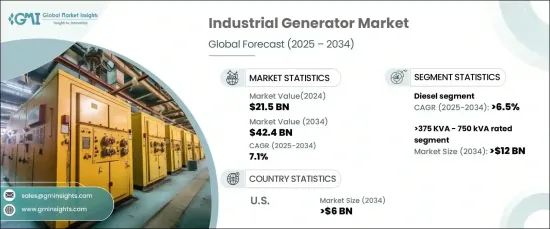
産業用発電機の世界市場は、2024年に215億米ドルとなり、2025年から2034年にかけてCAGR7.1%の堅調な成長が見込まれています。
この成長の原動力は、急速な工業化のペース、新興国におけるインフラの進歩、さまざまな分野における信頼性の高い無停電電源のニーズの高まりです。
産業用発電機は、停電時や送電網へのアクセスが不可能または信頼性の低い場所でも安定した電力を供給できるように設計されています。これらの発電機は、重要な産業環境におけるシームレスな操業を保証し、ピーク時のエネルギー需要をサポートし、遠隔地に電力を供給します。技術の進歩により、これらのシステムはさらに改良され、より厳しい持続可能性基準に沿った、燃料効率が高く環境に優しいモデルの開発につながっています。
| 市場範囲 | |
|---|---|
| 開始年 | 2024年 |
| 予測年 | 2025年~2034年 |
| 開始金額 | 215億米ドル |
| 予測金額 | 424億米ドル |
| CAGR | 7.1% |
375 kVA~750 kVAの発電機は、2034年までに120億米ドル以上を生み出すと予測されています。要求の厳しい産業作業や電力集約型機器を処理する能力があるため、ヘビーデューティーで信頼性の高い電力ソリューションを必要とする産業にとって好ましい選択肢となっています。さらに、遠隔地や非電化場所に適しているため、多様なエネルギーニーズを満たす上で魅力が増しています。
産業用発電機市場のディーゼルエンジン部門は、2034年まで6.5%を超える成長率が見込まれています。ディーゼル発電機は、その適応性、拡張性、多様な気象条件下での性能により、依然として人気が高いです。初期費用が比較的安く、出力が安定しているため、産業界全体で魅力的な選択肢となっています。産業用エネルギー需要の増加は、このセグメントの拡大にさらに貢献しています。
米国では、産業用発電機市場は2034年までに60億米ドルを突破すると見られています。操業効率を維持するためには継続的な電力供給が不可欠であるため、製造活動が大きな原動力になると予想されます。生産と財務に多大な損失をもたらしかねない停電の影響を軽減するため、これらのシステムを採用する企業が増えています。産業用発電機の耐久性、信頼性、大容量は、その採用拡大に貢献しています。
アジア太平洋地域は、電化強化と産業インフラ拡大に対する政府の取り組みにより、大幅な市場成長が見込まれています。産業用発電機は、安定した電力供給を確保するために、一次電源として、または再生可能エネルギーシステムと併用して使用されることが多くなっています。頻繁な停電と生産中断によるコスト上昇により、信頼性の高いバックアップソリューションの重要性が強調され、この地域の市場成長をさらに後押ししています。
目次
第1章 調査手法と調査範囲
- 市場範囲と定義
- 市場推計・予測パラメータ
- 予測計算
- データソース
- 一次
- 二次
- 有料
- 公的
第2章 エグゼクティブサマリー
第3章 業界洞察
- 業界エコシステム分析
- 規制状況
- 業界への影響要因
- 成長促進要因
- 業界の潜在的リスク・課題
- 成長可能性分析
- ポーター分析
- 供給企業の交渉力
- 買い手の交渉力
- 新規参入業者の脅威
- 代替品の脅威
- PESTEL分析
第4章 競合情勢
- イントロダクション
- 戦略的展望
- イノベーションと持続可能性の展望
第5章 市場規模・予測:定格出力別、2021年~2034年
- 主要動向
- 75 kVA以下
- 75 kVA~375 kVA
- 375 kVA~750 kVA
- 750 kVA以上
第6章 市場規模・予測:最終用途別、2021年~2034年
- 主要動向
- 石油・ガス
- 製造業
- 建設
- 電気事業
- 鉱業
- 運輸・物流
- その他
第7章 市場規模・予測:用途別、2021年~2034年
- 主要動向
- スタンバイ
- ピークカット
- プライム/コンティニュアス
第8章 市場規模・予測:燃料別、2021年~2034年
- 主要動向
- ディーゼル
- ガス
- その他
第9章 市場規模・予測:地域別、2021年~2034年
- 主要動向
- 北米
- 米国
- カナダ
- 欧州
- ロシア
- 英国
- ドイツ
- フランス
- スペイン
- オーストリア
- イタリア
- アジア太平洋
- 中国
- オーストラリア
- インド
- 日本
- 韓国
- インドネシア
- マレーシア
- タイ
- ベトナム
- フィリピン
- ミャンマー
- 中東
- サウジアラビア
- アラブ首長国連邦
- カタール
- トルコ
- イラン
- オマーン
- アフリカ
- エジプト
- ナイジェリア
- アルジェリア
- 南アフリカ
- アンゴラ
- ケニア
- ラテンアメリカ
- ブラジル
- メキシコ
- アルゼンチン
- チリ
第10章 企業プロファイル
- Ashok Leyland
- Atlas Copco
- Caterpillar
- Cummins
- Deere &Company
- FG Wilson
- Generac Power Systems
- Greaves Cotton
- Himoinsa
- JCB
- Kirloskar
- Kohler
- Mahindra Powerol
- Mitsubishi Heavy Industries
- MTU Onsite Energy
- Powerica
- Perkins Engines Company
- Supernova Genset
- Wartsila
- Yanmar Holdings
The Global Industrial Generator Market, valued at USD 21.5 billion in 2024, is anticipated to grow at a robust CAGR of 7.1% from 2025 to 2034. This growth is driven by the rapid pace of industrialization, infrastructure advancements in emerging economies, and the increasing need for reliable and uninterrupted power supply in various sectors.
Industrial generators are designed to provide consistent electrical power during outages or in locations where grid access is unavailable or unreliable. These generators ensure seamless operations in critical industrial settings, support peak energy demands, and power remote areas. Technological advancements have further refined these systems, leading to the development of fuel-efficient and environmentally friendly models that align with stricter sustainability standards.
| Market Scope | |
|---|---|
| Start Year | 2024 |
| Forecast Year | 2025-2034 |
| Start Value | $21.5 Billion |
| Forecast Value | $42.4 Billion |
| CAGR | 7.1% |
Generators with a capacity between 375 kVA and 750 kVA are projected to generate over USD 12 billion by 2034. Their capability to handle demanding industrial tasks and power-intensive equipment makes them a preferred choice for industries requiring heavy-duty and reliable power solutions. Additionally, their suitability for remote and off-grid locations enhances their appeal in meeting diverse energy needs.
The diesel-powered segment of the industrial generator market is expected to grow at a rate exceeding 6.5% through 2034. Diesel generators remain popular due to their adaptability, scalability, and ability to perform in varied weather conditions. Their relatively lower upfront costs and consistent power output make them an attractive option across industries. Rising industrial energy demands further contribute to the expansion of this segment.
In the U.S., the industrial generator market is set to surpass USD 6 billion by 2034. Manufacturing activities are expected to be a significant driver, as continuous power is essential to maintain operational efficiency. Businesses are increasingly adopting these systems to mitigate the impact of power outages, which can lead to significant production and financial losses. The durability, reliability, and high capacity of industrial generators contribute to their growing adoption.
Asia Pacific is poised to witness significant market growth due to government efforts to enhance electrification and expand industrial infrastructure. Industrial generators are increasingly used as primary power sources or in tandem with renewable energy systems to ensure a stable electricity supply. Frequent power outages and the rising cost of disruptions to production underline the importance of dependable backup solutions, further fueling market growth in this region.
Table of Contents
Chapter 1 Methodology & Scope
- 1.1 Market scope & definitions
- 1.2 Market estimates & forecast parameters
- 1.3 Forecast calculation
- 1.4 Data sources
- 1.4.1 Primary
- 1.4.2 Secondary
- 1.4.2.1 Paid
- 1.4.2.2 Public
Chapter 2 Executive Summary
- 2.1 Industry synopsis, 2021 - 2034
Chapter 3 Industry Insights
- 3.1 Industry ecosystem analysis
- 3.2 Regulatory landscape
- 3.3 Industry impact forces
- 3.3.1 Growth drivers
- 3.3.2 Industry pitfalls & challenges
- 3.4 Growth potential analysis
- 3.5 Porter's Analysis
- 3.5.1 Bargaining power of suppliers
- 3.5.2 Bargaining power of buyers
- 3.5.3 Threat of new entrants
- 3.5.4 Threat of substitutes
- 3.6 PESTEL Analysis
Chapter 4 Competitive Landscape, 2024
- 4.1 Introduction
- 4.2 Strategic outlook
- 4.3 Innovation & sustainability landscape
Chapter 5 Market Size and Forecast, By Power Rating, 2021 – 2034 ('000 Units & USD Million)
- 5.1 Key trends
- 5.2 ≤ 75 kVA
- 5.3 > 75 kVA - 375 kVA
- 5.4 > 375 KVA - 750 kVA
- 5.5 > 750 kVA
Chapter 6 Market Size and Forecast, By End Use, 2021 – 2034 ('000 Units & USD Million)
- 6.1 Key trends
- 6.2 Oil & gas
- 6.3 Manufacturing
- 6.4 Construction
- 6.5 Electric utilities
- 6.6 Mining
- 6.7 Transport & logistics
- 6.8 Others
Chapter 7 Market Size and Forecast, By Application, 2021 – 2034 ('000 Units & USD Million)
- 7.1 Key trends
- 7.2 Standby
- 7.3 Peak shaving
- 7.4 Prime/continuous
Chapter 8 Market Size and Forecast, By Fuel, 2021 – 2034 ('000 Units & USD Million)
- 8.1 Key trends
- 8.2 Diesel
- 8.3 Gas
- 8.4 Others
Chapter 9 Market Size and Forecast, By Region, 2021 – 2034 ('000 Units & USD Million)
- 9.1 Key trends
- 9.2 North America
- 9.2.1 U.S.
- 9.2.2 Canada
- 9.3 Europe
- 9.3.1 Russia
- 9.3.2 UK
- 9.3.3 Germany
- 9.3.4 France
- 9.3.5 Spain
- 9.3.6 Austria
- 9.3.7 Italy
- 9.4 Asia Pacific
- 9.4.1 China
- 9.4.2 Australia
- 9.4.3 India
- 9.4.4 Japan
- 9.4.5 South Korea
- 9.4.6 Indonesia
- 9.4.7 Malaysia
- 9.4.8 Thailand
- 9.4.9 Vietnam
- 9.4.10 Philippines
- 9.4.11 Myanmar
- 9.5 Middle East
- 9.5.1 Saudi Arabia
- 9.5.2 UAE
- 9.5.3 Qatar
- 9.5.4 Turkey
- 9.5.5 Iran
- 9.5.6 Oman
- 9.6 Africa
- 9.6.1 Egypt
- 9.6.2 Nigeria
- 9.6.3 Algeria
- 9.6.4 South Africa
- 9.6.5 Angola
- 9.6.6 Kenya
- 9.7 Latin America
- 9.7.1 Brazil
- 9.7.2 Mexico
- 9.7.3 Argentina
- 9.7.4 Chile
Chapter 10 Company Profiles
- 10.1 Ashok Leyland
- 10.2 Atlas Copco
- 10.3 Caterpillar
- 10.4 Cummins
- 10.5 Deere & Company
- 10.6 FG Wilson
- 10.7 Generac Power Systems
- 10.8 Greaves Cotton
- 10.9 Himoinsa
- 10.10 JCB
- 10.11 Kirloskar
- 10.12 Kohler
- 10.13 Mahindra Powerol
- 10.14 Mitsubishi Heavy Industries
- 10.15 MTU Onsite Energy
- 10.16 Powerica
- 10.17 Perkins Engines Company
- 10.18 Supernova Genset
- 10.19 Wartsila
- 10.20 Yanmar Holdings