


エンタープライズ向けジェネレーティブAI市場の機会、成長促進要因、産業動向分析、2025年~2034年の予測
Enterprise Generative AI Market Opportunity, Growth Drivers, Industry Trend Analysis, and Forecast 2025-2034


- 発行日
- ページ情報
- 英文 175 Pages
- 納期
- 2~3営業日
- 商品コード
- 1698334
- カスタマイズ可能 お客様のご希望に応じて、既存データの加工や未掲載情報(例:国別セグメント)の追加などの対応が可能です。詳細はお問い合わせください。
- 翻訳ツール提供対象 PDF対応AI翻訳ツールの無料貸し出しサービスのご利用が可能です
概要
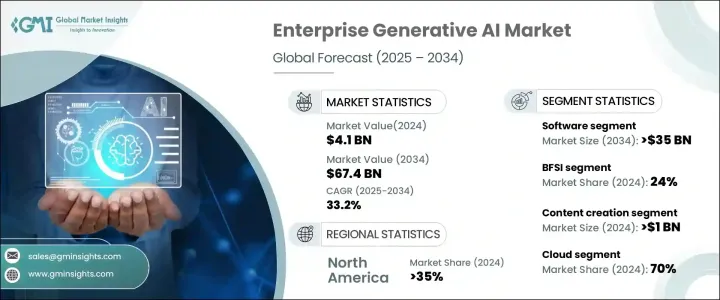
エンタープライズ向けジェネレーティブAIの世界市場規模は2024年に41億米ドルとなり、2025年から2034年にかけてCAGR 33.2%で拡大すると予測されています。
企業はコンテンツ生成、顧客エンゲージメント、ソフトウェア開発、財務分析にジェネレーティブAIを活用するケースが増えています。反復作業を自動化することで、AIは効率を高め、運用コストを削減し、生産性を最適化します。自動化されたツールは、ビジネス文書、マーケティング資料、法的文書、さらにはソフトウェア・アプリケーションを生成し、業界全体のワークフローを合理化します。報告によると、企業の4分の3近くがすでにAIによる自動化を業務に組み込んでおり、半数以上が2026年までにさらなる投資を計画しています。
組織はまた、サイバーセキュリティの脅威を監視し、不正行為を検出し、セキュリティリスクを軽減するためにAIを導入しています。AIを搭載したシステムは、トランザクション、ネットワーク・トラフィック、ユーザー行動を分析し、疑わしい活動を特定します。金融、eコマース、サイバーセキュリティの各分野では、ディープラーニング・アルゴリズムを活用してセキュリティの枠組みを強化しています。企業は、サイバーセキュリティの防御を強化するために、AI主導のソリューションを積極的に開発しており、ディープフェイクを検出し、機密データを保護するツールを組み込んでいます。
| 市場範囲 | |
|---|---|
| 開始年 | 2024 |
| 予測年 | 2025-2034 |
| 開始金額 | 41億米ドル |
| 予測金額 | 674億米ドル |
| CAGR | 33.2% |
コンポーネントの観点から、市場はソフトウェアとサービスに分類されます。ソフトウェア分野は2024年に市場の65%以上を占め、2034年には350億米ドルを超えると予測されています。業界に特化したAIアプリケーションは、金融、ヘルスケア、小売で人気を集めており、ニーズに合わせた洞察を提供し、複雑な意思決定を可能にしています。AI主導のコンプライアンス・ソリューションは、金融セクターで採用され、報告を自動化し、リスクを低減しながら規制遵守を確実にしています。企業はカスタマイズ可能なAIソフトウェアを求めるようになっており、プロバイダーはAPIを強化し、ノーコード・プラットフォームを導入し、最小限の技術的専門知識を必要とする自己学習アルゴリズムを開発しています。こうしたイノベーションにより、さまざまな分野でAIの導入が加速しています。
CRMやERPシステムなどの企業向けツールは、生成AIを統合して洞察を引き出し、主要なプロセスを自動化しています。AI分析プラットフォームは、レポートの生成、動向の追跡、予測分析の提供により、データ主導の意思決定を促進します。金融機関はリアルタイムの取引監視、不正検知、リスク評価にAIを活用しています。AIモデルは信用力を評価し、コンプライアンス・レポートを作成し、マネーロンダリング活動を特定することで、金融プロセスをより安全かつ効率的にします。AIを搭載したバーチャルアシスタントやチャットボットは、顧客とのやり取りを管理し、金融ガイダンスを提供し、保険金請求処理を自動化することで、顧客サービスと業務効率の両方を向上させる。銀行や保険会社は規制当局への報告や監査にAIを活用し、手作業を最小限に抑えながら正確性を高めています。
用途別に見ると、市場はコンテンツ制作、商品開拓、顧客サポート、マーケティング、サプライチェーン管理に区分されます。コンテンツ作成分野が市場を牽引し、2024年には10億米ドル超を創出します。企業はAIを利用して、ターゲットを絞ったマーケティングコピー、SEOに最適化された記事、デジタルコンテンツを作成し、生産性を高めながらコストを大幅に削減しています。AIを搭載したツールにより、企業は広告やeコマース向けの高品質なビジュアルコンテンツや文章コンテンツを迅速に生成することができます。AI主導のプラットフォームは、コンテンツ戦略の管理、ワークフローの自動化、デジタル・エンゲージメントの強化において企業をサポートします。
導入に関しては、市場はオンプレミスとクラウドベースのソリューションに分けられます。クラウドセグメントは、2024年の市場の70%近くを占めています。企業は、その柔軟性、費用対効果、拡張性からクラウドベースのAIを好んでいます。クラウド・ホスト型AIモデルは、大規模なオンサイト・インフラを必要とすることなく、高度なAI機能へのシームレスなアクセスを提供します。企業はクラウドベースのAIツールをレポートの自動化、ビジネス・インテリジェンス・タスクの実行、コラボレーションの合理化に活用しています。AI主導のシステムは、膨大な量の構造化データおよび非構造化データを処理し、企業運営を最適化します。
小売、金融、ヘルスケアの各組織は、AIを搭載したチャットボットやバーチャルアシスタントを統合し、顧客との対話をパーソナライズしています。
北米は依然として主要な導入国であり、米国の企業はリスク評価、自動請求処理、予測分析にAIを活用しています。金融やヘルスケア分野では、不正行為の検出、コンプライアンスの合理化、患者ケアの強化のためにAIが導入されています。大手クラウド・プロバイダーはAI-as-a-Serviceソリューションを提供し、あらゆる規模の企業がジェネレーティブAIにアクセスできるようにしています。AI新興企業への投資がイノベーションを促進し続け、業界全体でジェネレーティブAIの導入が加速しています。
目次
第1章 調査手法と調査範囲
- 調査デザイン
- 調査アプローチ
- データ収集方法
- 基本推定と計算
- 基準年の算出
- 市場推計の主要動向
- 予測モデル
- 1次調査と検証
- 市場範囲と定義
第2章 エグゼクティブサマリー
第3章 業界洞察
- エコシステム分析
- AIソフトウェアプロバイダー
- サービスプロバイダー
- データプロバイダー
- システムインテグレーター
- エンドユース
- サプライヤーの状況
- 利益率分析
- テクノロジーとイノベーションの展望
- 特許分析
- 主要ニュースと取り組み
- 規制状況
- ジェネレーティブAIが労働力と職務に与える影響
- ケーススタディ
- 影響要因
- 促進要因
- AIによる自動化を導入する企業の増加
- AIを活用したコンテンツ制作の進展
- AIを活用したカスタマーサポートやバーチャルアシスタントへの需要の高まり
- クラウドコンピューティングとジェネレーティブAIの統合の拡大
- 業界の潜在的リスク&課題
- AI生成コンテンツを取り巻く倫理的・規制的課題
- 高い計算コストとインフラ要件
- 促進要因
- 成長可能性分析
- ポーター分析
- PESTEL分析
第4章 競合情勢
- イントロダクション
- 企業シェア分析
- 競合のポジショニング・マトリックス
- 戦略展望マトリックス
第5章 市場推計・予測:コンポーネント別、2021年~2034年
- 主要動向
- ソフトウェア
- サービス
第6章 市場推計・予測:展開モデル別、2021年~2034年
- 主要動向
- オンプレミス
- クラウド
第7章 市場推計・予測:モデル別、2021年~2034年
- 主要動向
- テキスト
- 画像
- 音声
- コード
第8章 市場推計・予測:技術別、2021年~2034年
- 主要動向
- 生成逆数ネットワーク(GANs)
- トランスフォーマーモデル
- 変分オートエンコーダ
- 拡散モデル
- その他
第9章 市場推計・予測:用途別、2021年~2034年
- 主要動向
- コンテンツ制作
- 製品設計・開発
- カスタマーサービス&サポート
- マーケティング&パーソナライゼーション
- サプライチェーンマネジメント
- その他
第10章 市場推計・予測:最終用途別、2021年~2034年
- 主要動向
- ヘルスケア
- 小売・eコマース
- 製造業
- BFSI
- メディア・エンターテイメント
- 自動車
- IT・通信
- その他
第11章 市場推計・予測:地域別、2021年~2034年
- 主要動向
- 北米
- 米国
- カナダ
- 欧州
- 英国
- ドイツ
- フランス
- イタリア
- スペイン
- ロシア
- 北欧
- アジア太平洋
- 中国
- インド
- 日本
- オーストラリア
- 韓国
- 東南アジア
- ラテンアメリカ
- ブラジル
- メキシコ
- アルゼンチン
- 中東・アフリカ
- UAE
- 南アフリカ
- サウジアラビア
第12章 企業プロファイル
- Accenture
- Adobe
- AWS
- Baidu
- C3.ai
- DeepMind Technologies
- H20.ai
- IBM
- Intel
- Jasper.ai
- Microsoft
- Nvidia
- NVIDIA
- OpenAI
- Oracle
- Qualcomm
- Salesforce
- SAP
- UiPath
目次
The Global Enterprise Generative AI Market was valued at USD 4.1 billion in 2024 and is projected to expand at a CAGR of 33.2% between 2025 and 2034. Businesses are increasingly leveraging generative AI for content generation, customer engagement, software development, and financial analysis. By automating repetitive tasks, AI enhances efficiency, reduces operational costs, and optimizes productivity. Automated tools generate business correspondence, marketing materials, legal documents, and even software applications, streamlining workflows across industries. Reports indicate that nearly three-quarters of enterprises have already integrated AI-driven automation into their operations, with more than half planning further investments by 2026.
Organizations are also deploying AI to monitor cybersecurity threats, detect fraud, and mitigate security risks. AI-powered systems analyze transactions, network traffic, and user behavior to identify suspicious activities. The financial, e-commerce, and cybersecurity sectors are utilizing deep learning algorithms to fortify security frameworks. Companies are actively developing AI-driven solutions to enhance cybersecurity defenses, incorporating tools that detect deepfakes and secure sensitive data.
| Market Scope | |
|---|---|
| Start Year | 2024 |
| Forecast Year | 2025-2034 |
| Start Value | $4.1 Billion |
| Forecast Value | $67.4 Billion |
| CAGR | 33.2% |
In terms of components, the market is categorized into software and services. The software segment accounted for over 65% of the market in 2024 and is anticipated to surpass USD 35 billion by 2034. Industry-specific AI applications are gaining traction in finance, healthcare, and retail, offering tailored insights and enabling complex decision-making. AI-driven compliance solutions are being adopted in the financial sector to automate reporting, ensuring regulatory adherence while reducing risks. Businesses are increasingly seeking customizable AI software, prompting providers to enhance APIs, introduce no-code platforms, and develop self-learning algorithms that require minimal technical expertise. These innovations are accelerating AI adoption across diverse sectors.
Enterprise tools such as CRM and ERP systems are integrating generative AI to extract insights and automate key processes. AI analytics platforms facilitate data-driven decision-making by generating reports, tracking trends, and offering predictive analytics. Financial institutions leverage AI for real-time transaction monitoring, fraud detection, and risk assessment. AI models assess creditworthiness, generate compliance reports, and identify money laundering activities, making financial processes more secure and efficient. AI-powered virtual assistants and chatbots manage client interactions, provide financial guidance, and automate claims processing, improving both customer service and operational efficiency. Banks and insurance firms utilize AI for regulatory reporting and audits, enhancing accuracy while minimizing manual effort.
By application, the market is segmented into content creation, product development, customer support, marketing, and supply chain management. The content creation segment led the market, generating over USD 1 billion in 2024. Companies are using AI to produce targeted marketing copy, SEO-optimized articles, and digital content, significantly cutting costs while increasing output. AI-powered tools enable businesses to rapidly generate high-quality visual and written content for advertising and e-commerce. AI-driven platforms support enterprises in managing content strategies, automating workflows, and enhancing digital engagement.
In terms of deployment, the market is divided into on-premises and cloud-based solutions. The cloud segment accounted for nearly 70% of the market in 2024. Companies prefer cloud-based AI due to its flexibility, cost-effectiveness, and scalability. Cloud-hosted AI models provide seamless access to advanced AI capabilities without requiring extensive on-site infrastructure. Businesses utilize cloud-based AI tools for automating reports, executing business intelligence tasks, and streamlining collaboration. AI-driven systems process vast amounts of structured and unstructured data, optimizing enterprise operations.
Organizations across retail, finance, and healthcare are integrating AI-powered chatbots and virtual assistants to personalize customer interactions.
North America remains a leading adopter, with businesses in the United States leveraging AI for risk assessment, automated claims processing, and predictive analytics. The financial and healthcare sectors are incorporating AI to detect fraud, streamline compliance, and enhance patient care. Leading cloud providers are offering AI-as-a-Service solutions, making generative AI accessible to enterprises of all sizes. Investments in AI startups continue to drive innovation, accelerating the adoption of generative AI across industries.
Table of Contents
Chapter 1 Methodology & Scope
- 1.1 Research design
- 1.1.1 Research approach
- 1.1.2 Data collection methods
- 1.2 Base estimates & calculations
- 1.2.1 Base year calculation
- 1.2.2 Key trends for market estimation
- 1.3 Forecast model
- 1.4 Primary research and validation
- 1.4.1 Primary sources
- 1.4.2 Data mining sources
- 1.5 Market scope & definition
Chapter 2 Executive Summary
- 2.1 Industry synopsis, 2021 - 2034
Chapter 3 Industry Insights
- 3.1 Industry ecosystem analysis
- 3.1.1 AI software providers
- 3.1.2 Service providers
- 3.1.3 Data providers
- 3.1.4 System integrators
- 3.1.5 End use
- 3.2 Supplier landscape
- 3.3 Profit margin analysis
- 3.4 Technology & innovation landscape
- 3.5 Patent analysis
- 3.6 Key news & initiatives
- 3.7 Regulatory landscape
- 3.8 Impact of generative AI on workforce and job roles
- 3.9 Case studies
- 3.10 Impact forces
- 3.10.1 Growth drivers
- 3.10.1.1 Increasing enterprise adoption of AI-driven automation
- 3.10.1.2 Advancements in AI-powered content creation
- 3.10.1.3 Rising demand for AI-driven customer support and virtual assistants
- 3.10.1.4 Growing integration of generative AI with cloud computing
- 3.10.2 Industry pitfalls & challenges
- 3.10.2.1 Ethical and regulatory challenges surrounding AI-generated content
- 3.10.2.2 High computational costs and infrastructure requirements
- 3.10.1 Growth drivers
- 3.11 Growth potential analysis
- 3.12 Porter's analysis
- 3.13 PESTEL analysis
Chapter 4 Competitive Landscape, 2024
- 4.1 Introduction
- 4.2 Company market share analysis
- 4.3 Competitive positioning matrix
- 4.4 Strategic outlook matrix
Chapter 5 Market Estimates & Forecast, By Component, 2021 - 2034 ($Bn)
- 5.1 Key trends
- 5.2 Software
- 5.3 Services
Chapter 6 Market Estimates & Forecast, By Deployment Model, 2021 - 2034 ($Bn)
- 6.1 Key trends
- 6.2 On-premises
- 6.3 Cloud
Chapter 7 Market Estimates & Forecast, By Model, 2021 - 2034 ($Bn)
- 7.1 Key trends
- 7.2 Text
- 7.3 Image
- 7.4 Audio
- 7.5 Code
Chapter 8 Market Estimates & Forecast, By Technology, 2021 - 2034 ($Bn)
- 8.1 Key trends
- 8.2 Generative Adversarial Networks (GANs)
- 8.3 Transformers model
- 8.4 Variational auto-encoders
- 8.5 Diffusion models
- 8.6 Others
Chapter 9 Market Estimates & Forecast, By Application, 2021 - 2034 ($Bn)
- 9.1 Key trends
- 9.2 Content creation
- 9.3 Product design & development
- 9.4 Customer service & support
- 9.5 Marketing & personalization
- 9.6 Supply chain management
- 9.7 Others
Chapter 10 Market Estimates & Forecast, By End Use, 2021 - 2034 ($Bn)
- 10.1 Key trends
- 10.2 Healthcare
- 10.3 Retail and e-commerce
- 10.4 Manufacturing
- 10.5 BFSI
- 10.6 Media and entertainment
- 10.7 Automotive
- 10.8 IT & telecom
- 10.9 Others
Chapter 11 Market Estimates & Forecast, By Region, 2021 - 2034 ($Bn, Units)
- 11.1 Key trends
- 11.2 North America
- 11.2.1 U.S.
- 11.2.2 Canada
- 11.3 Europe
- 11.3.1 UK
- 11.3.2 Germany
- 11.3.3 France
- 11.3.4 Italy
- 11.3.5 Spain
- 11.3.6 Russia
- 11.3.7 Nordics
- 11.4 Asia Pacific
- 11.4.1 China
- 11.4.2 India
- 11.4.3 Japan
- 11.4.4 Australia
- 11.4.5 South Korea
- 11.4.6 Southeast Asia
- 11.5 Latin America
- 11.5.1 Brazil
- 11.5.2 Mexico
- 11.5.3 Argentina
- 11.6 MEA
- 11.6.1 UAE
- 11.6.2 South Africa
- 11.6.3 Saudi Arabia
Chapter 12 Company Profiles
- 12.1 Accenture
- 12.2 Adobe
- 12.3 AWS
- 12.4 Baidu
- 12.5 C3.ai
- 12.6 DeepMind Technologies
- 12.7 Google
- 12.8 H20.ai
- 12.9 IBM
- 12.10 Intel
- 12.11 Jasper.ai
- 12.12 Microsoft
- 12.13 Nvidia
- 12.14 NVIDIA
- 12.15 OpenAI
- 12.16 Oracle
- 12.17 Qualcomm
- 12.18 Salesforce
- 12.19 SAP
- 12.20 UiPath
- 発行日
- 発行
- Global Market Insights Inc.
- ページ情報
- 英文 175 Pages
- 納期
- 2~3営業日


